A discussion of architecture and fractals can lead to ambiguous territory [Ostwald 2001; Balmond 1997; Jencks 1997a; Jencks 1997b; Eisenman 1986]. The aim of the present paper is to test with regards to architectural elements certain concepts that are proper to fractal geometry. The purpose is not to show that the architectural orders are true fractal objects, but rather that how fractal "instruments" can be used to approach certain objects and what kinds of information can be gleaned by such an approach. It is worthwhile mentioning that an architectural element is only approximately fractal, since it cannot have details that are infinitely small; thus, in this regard, I prefer not to speak of "fractal architecture," but rather of architecture "with a fractal nature."
As a guide, we can take the definition of fractal sets F laid out by Flaconer [1990: xx-xxi]:
i. F has a fine structure, that is, details at an arbitrarily small scale;
ii. F is too irregular to be described in a traditional geometric language, both locally and globally;
iii.F often has some form of self-similarity, perhaps approximate or statistical.
iv. Usually the "fractal dimension" of F (defined in one way or another) is greater than its topological dimension;
v. In the most part of the cases, F can be defined in a very simple way, perhaps recursively.
In the field of architecture, Carl Bovill [1996] performed a fractal analysis by measuring, by means of the method of box-counting, the fractal dimension of some works of Wright and Corbusier. In the present paper I would like to make some observations on the implications of an architecture with a fractal nature, and in particular, to demonstrate how a discussion of this kind is well suited to the architectural orders (it appears that thus far the architectural orders have never been subject to a fractal interpretation).
The architectural orders can be taken as meaningful case studies for several reasons. In the first place, the object of study is easily defined; secondly, the analysis can be limited only to vertical successions of elements that are clearly disparate; through focussing on only one dimension, an analysis can be perfomed in a systematic and precise fashion.
In spite of its simplicity, or perhaps because of it, the example of the architectural orders furnishes a very clear image of how fractal analysis can be applied to architecture in general and contributes to the resolution of the ambivalence concerning the meaning of the term "fractal" in the field of architecture.
A DEFINITION OF THE OBJECT UNDER EXAMINATION
The architectural orders taken into consideration are those defined by Palladio in his treatise on architecture (Fig. 1) [Palladio 1992: 30-67]. The analysis will focus on the succession of vertical elements. In essence, one takes the intersection between a straight line and the segments that separate one element from another, and this set of points is considered to be the element in question. This may appear to be an over-simplification, but it is also true that in this way a complete analysis is made possible. Further, the error that might be due to this abstraction can, at the most, result in the de-fractalization of the order. Thus, if we are able to demonstrate a coherence between our abstraction and the fractal hypothesis, then we are justified in saying that the actual order also possesses a fractal nature, perhaps even greater than that which we hypothesized. For now, however, let us accept the idea of investigating the way in which the surface is structured in one dimension.
METHODOLOGY
There are two methods by which the investigation is carried out. The first consists in measuring the box-counting dimension of the set of points defined above. The second consists in an analysis of the relationship between number and dimension of the intervals between the points (that is, of the elements that form the architectural order).
With the first method (Fig. 2), we count the number of small squares that are "occupied" by some point of the set being investigated, and at each successive passage, we divide the side of the square by two. Rather than using the classic method of box-counting, we will use a slightly modified version, "the information dimension" [1], which takes into consideration the number of points that fall in each square. The values obtained are placed on a graph so that the number of squares occupied are laid out on the x-axis, and the logarithm of the inverse of the side of the square are laid out on the y-axis.[2] By means of a statistical analysis the straight line is obtained that best approximates the distribution of points and the coefficient of correlation, which tells how valid it is. The slant of the line represents the fractal dimension of the set of points for the architectural order. In order to obtain the dimension of the architectural order (that is, the dimension of the original drawing, taking into account only the horizontal rows), it is sufficient to add 1 to the result obtained.[3]
The second method (Fig. 3) consists in counting the number of spaces with a length greater than length u, which is varied by halving it. The result is placed on a logarithmic graph in which the number of spaces is laid out on the x-axis, and the value of u on the y-axis. This system derives from the kind of analysis suggested by Nikos Salingaros.[4] In this case as well it is necessary to determine the slant of the line that best approximates the data and the degree of correlation between the two.
It should be observed that the advantage of undertaking an analysis of only one dimension is that the trend of the data can be immediately visualized. Given that we are talking about a set of points and not of a true fractal, it can be expected that, when the investigation is refined, the result tends to zero;[5] what counts is how slowly it does so (that is, how much more it tends towards an authentic fractal). This is easily verified from the point where the curve formed by the data flattens out to the point of becoming horizontal. The fractal coherence can be estimated, then, by means of a simple visual comparison of the data, which is not so automatic if the investigation is extended into the plane. In this case we have the values of the dimensions tending towards one, which is more difficult to perceive with the naked eye.[6]
COMPARISION
The analysis thus conducted leads to a set of results, but it is important that they be compared with a control situation purposely constructed to possess given fractal characteristics. Analyzing our "artificial" order provides us with a kind of litmus paper which allows us to verify the investigation. The limit that we imposed of treating only the succession of vertical elements once again works to our advantage in that we can easily construct a similar paragon. We can imagine reading the succession of elements typical of the architectural orders as a Cantor set. In fact, in the former as in the latter, we find large spaces surrounded by small spaces that are, in their turn, surrounded by still smaller spaces. At this point we must define a model based on a modification of the traditional Cantor set and subject it to analysis (Fig. 4). A first check can be effected by a direct visual comparison, drawing an architectural order and putting it next to a real one. When a certain plausibility of the hypothsis on the basis of the model is observed, we go to the same investigation discussed earlier in the section on methodology, and the results are compared.
RESULTS OF THE INVESTIGATION
The fractal analysis conducted on three orders of Palladio, the Corinthian, the Doric, and the Composite, and on the control model, showed a fundamental coherence with a fractal interpretation.
The "information dimension" method shows that all three of Palladio's orders maintain a certain consistency of the data up to the eighth level, indicating that the value of the dimension is demolished only when the count is based on squares with a small side that is equal to 1/256 of the height of the entire order. If we consider a total height of 10 meters, we can conclude that the fractal coherence is maintained down to a detail of 4 centimeters, which is not surprising considering that, in the architectural orders, that are mouldings that are exceedingly small.
The second method validates the results of the first, showing how the number of elements continues to increase as their height gradually diminishes, a characteristic that is essential to fractal objects. In this case, as above, the most important result is the large interval on which the fractal interpretation has been effected. The trend not being perfectly linear would seem to deny that this is true, even though the coefficient of correlation is still very high, but if the form of the graph is carefully considered, it can be discerned that the most important element is the tendency of the details to grow as their height decreases.
The "control" order, explicitly constructed with a fractal recursion, furnishes results that are very similar to those obtained from the analysis of Palladio's orders, reinforcing still more this interpretation. This helps us to understand that the jumps present in the graph relative to the second method are inevitable.[7]
The fractal dimension measured is not fixed, as can be easily verified in the graphs, but oscillates. The important thing is to notice that it also oscillates for the control order, and is greater than than the theoretical one that is known in this case. The problem therefore reduces down to two facts: the first is that the method itself has limits, as was noted above; the second is that we must not consider the orders as "simple" fractals, but rather as examples of multi-fractals in which diverse dimensions coexist.[8] Even taking into account these limits, it can be brought out in any case that the dimension runs between 0.6 and 0.7.[9] Knowing that these values are approximate by excess, we can in any case affirm that the dimension can be collocated in a position that tends to mediate between 0 and 1, where 0 represents the null set (a total absence of any element of interest) and 1 the completely full set (visual chaos, where every part is filled) (Fig. 5). The geometry of these architectural objects strike a balance between the two extremes, a fact that is held to be extremely important by both Mandelbrot [1981: 45-47] and Eglash [1999: 171].
Understanding the orders, which for centuries have provided the basis for Western architecture, in light of the analysis presented above, brings us to certain considerations. The first is that it allows us to observe, through the analysis of numerical data, how small elements are inserted in a continuous and coherent whole. If we interpret this structure fractally we do not distinguish between the essential and the inessential; everything is essential and so creates in this way a greater (fractal) coherence. It could be said, in this light, that the general form is not what counts the most, but rather, what is really important is the way in which parts hold together. For example, by means of this analysis it could be said that the "abstractions" that reduced the architectural orders to their principal elements (as in certain architectures of totalitarian regimes of the first half of the last century) did not grasp this fact, while an architect like Wright [10], even while not replicating the form of the orders, realized an architecture which, from the point of view of fractals, came very close to them.
The second observation is that the Cantor set constitutes an approximate yet realistic model of the kind of fractal geometry exemplified by the architectural orders. This idea could be carried forward by hypothesizing a simple process of "budding out" which gives rise to structural architectural systems of a similar nature (Fig. 6). Starting with few elements, a pier on a plinth, experiments could be undertaken to see what would happen when a greater number of elements was distinguished, introducing others above and beneath, and continuing this operation a certain number of times. It can be readily observed that this means of proceeding, based on a simple logic, is capable of generating a very high level of differentiation, giving rise in the end to something that comes very close to the actual forms taken by the architectural orders through history. The kind of structuring that we have seen presents us then with a peculiarity from the point of view of perception. In fact, we can affirm that structures with fractal natures are visually very robust. We can observe this by comparing two drawings, one representing Sierpinski's carpet, the other a square subdivided into smaller squares (Fig. 7). By slightly modifying the two drawings it can be seen that the second reflects the effects of modification in an accentuated way, while the first seems effected to a lesser degree. This characteristic of fractal figures could account for the fact that the architectural orders, even while subject to modifications in the parts of which they are constituted, maintain their "order;" if their geometry was not of the fractal nature discussed in this paper, the order would diminish.
NOTES
[1] The "information dimension" consists in keeping a count of the greater or lesser probability that a square will be "filled" by some part of the figure. For the definition, see [Peitgen, et al. 1998]. return to text
[2] For our purposes we consider the height of the entire architectural order, from the ground to the uppermost moulding, to be one unit. return to text
[3] This problem can be taken back to that of the multiplication of two sets with different fractal dimensions, the dimension of which is equal to the sum of the dimensions. Cf. [Falconer 1990]. return to text
[4] For a discussion of Salingaros's position on "fractal" architecture, see [Salingaros and West 1999]. The method that we suggest can also be extracted from the analysis of Mandelbrot [1987] of the Cantor set. The links between the architectural orders and the Cantor set will become evident later in the text. return to text
[5] A fractal object such as the Cantor set will never tend to zero but, in the case of real objects, we cannot ever arrive at this level of abstraction. For this reason we have introduced the definition of architecture as having a "fractal nature," to indicate that architecture which, within certain limits, behaves in a way that is similar to a fractal. return to text
[6] It is possible to propose a different means of representation which would still present the same advantages given above. return to text
[7] In essence, the form of the graph is effected by the fact that the length u has been halved each time. The jumps represent the fact that in those points the height of the elements "jumped" in a more rapid manner. return to text
[8] We are unable to find actual examples of applications of methods of multi-fractal analysis to architecture. Within the limits of this brief paper we can only advance the hypothesis that a similar approach can furnish new information about the geometry of architecture. return to text
[9] 0.6 and 0.7 are the dimensions of the set of points that has been found with our analysis. The dimension of the succession of mouldings varies therefore between 1.6 and 1.7. return to text
[10] For studies of Wright's architecture with regards to fractals, see [Bovill 1996] and [Eaton 1998]. return to text
Daniele Capo, "The Fractal Nature of the Architectural Orders", Nexus Network Journal, vol. 6 no. 1 (Spring 2004), http://www.nexusjournal.com/Capo.html
13 de enero de 2006


4 de enero de 2006
Rafael Moneo abre 2006 en el podcast de SCALAE

Mi lugar favorito para compras compulsivas es la librería de la Escuela de Arquitectura de Madrid, que recomiendo como alternativa a las habitualmente huecas estanterías TASCHEN de los VIPS...
Afortunadamente para mi bolsillo, a las 19:00 horas cierra sus puertas, con lo que no me suele quedar otro remedio que pasar la vista por el escaparate, con la tienda ya cerrada, para codiciar lo expuesto tras el cristal.
En mi última visita a tienda abierta, me hice con una preciosa edición retro del Modulor de Le Corbusier (Ed. Apóstrofe), "Inchoate, an experiment in architectural education", de Marc Angelil (Actar), y "KM3, excursions on capacities", megalibro y DVD de MVRDV (también de Actar). En otros post iré comentando mi impresión a estas lecturas.
A última hora, incluí instintivamente una pequeña publicación desplegable, atraido por la entrevista, anunciada en portada, con Tuñón y Mansilla.
De ese modo di con los Pliegos SCALAE, y tirando de la madeja, con su blog, sus podcast y su acuario. Me divirtió bastante la visita, y me inspiró para hacer un divertimento sobre peces fractales. En mi bloqueado disco duro descansaban todos los podcast, que ahora estoy volviendo a descargar.
Recomiendo vivamente una visita a , aunque me consta que muchos lo conoceis, porque habeis hecho el camino inverso, gracias al pez que Felix Arranz ha tenido la gentileza de incluir en su acuario.
Espero que disfruteis como yo lo he hecho, con las conversaciones con nuevos arquitectos, o con consagrados de la talla de Guallart o Llinás. Como regalo de año nuevo, SCALAE nos ha traido, como avance de lo que será 2006, nada menos que una conversación con Rafael Moneo...
2006 y la conjura de los aparatos
El año ha comenzado con una extraña conjura de aparatos eléctricos... Porque no puede ser casual -no, no puede serlo- que un lavavajillas, un disco duro portátil, un cepillo de dientes eléctrico, y una conexión a Internet, se hayan estropeado a la vez. Podría haber ocurrido en el cambio de milenio, pero estamos en 2006, y cada una de las averías responde, al parecer, a motivos diferentes...
El lavavajillas se estropeó, a decir del técnico, por una sobrecarga de tensión (entiendo que achacable a la compañía eléctrica). El infarto electrónico hizo que el cerebro del aparato se negara a pedir agua de la toma, como el nuestro se puede negar a que las piernas intenten caminar... Y como la placa viene sellada con una capa de silicona, lo que antes se arreglaba cambiando un componente o un fusible, exige hoy un trasplante completo. Quizás el lavavajillas se ha automutilado, en un gesto de rebeldía contra la sobredosis de detergente que acompaña a estas fechas.
Lo de la memoria portátil es más grave, en la medida en que muchos ingenuos aprovechamos estas fechas para formatear el disco duro interno, para hacer limpieza de archivos obsoletos o corruptos. De modo que hoy me encuentro huérfano de miles de bytes (im)prescindibles, que se resisten a salir de sus sectores tras la resaca de fin de año... Se da la paradoja adicional de que, mientras se anuncian discos duros portátiles con 160 Gb por menos de 200 €, el servicio técnico me amenaza con una factura estratosférica si quiero recuperar mis 30 Gb de vivencias varias. Está claro que, en este caso, se trata de una venganza del disco auxiliar, en respuesta a la ejecución de los archivos homónimos del disco interno.
El cepillo de dientes ha pasado a mejor vida sin más, negándose a recargar, tras una rutinaria vida de dos años. Curiosamente, se va, como llegó, cerca del día de Reyes... ¿Estarán programados para su autodestrucción y reposición?
Por último, Telefónica ha tenido a bien felicitar el nuevo año a algunos usuarios de tarifa plana, con la suspensión del servicio durante un par de días. Sin duda lo ha hecho por nuestro bien, para que nos dediquemos intensamente a la vida familiar... Pero me angustia comprobar, cuando no la tienes, la dependencia que causa la información que llega cada día a través de Internet.
En definitiva, el año ha comenzado con extrañas coincidencias. Es decir, como cualquier otro año...
El lavavajillas se estropeó, a decir del técnico, por una sobrecarga de tensión (entiendo que achacable a la compañía eléctrica). El infarto electrónico hizo que el cerebro del aparato se negara a pedir agua de la toma, como el nuestro se puede negar a que las piernas intenten caminar... Y como la placa viene sellada con una capa de silicona, lo que antes se arreglaba cambiando un componente o un fusible, exige hoy un trasplante completo. Quizás el lavavajillas se ha automutilado, en un gesto de rebeldía contra la sobredosis de detergente que acompaña a estas fechas.
Lo de la memoria portátil es más grave, en la medida en que muchos ingenuos aprovechamos estas fechas para formatear el disco duro interno, para hacer limpieza de archivos obsoletos o corruptos. De modo que hoy me encuentro huérfano de miles de bytes (im)prescindibles, que se resisten a salir de sus sectores tras la resaca de fin de año... Se da la paradoja adicional de que, mientras se anuncian discos duros portátiles con 160 Gb por menos de 200 €, el servicio técnico me amenaza con una factura estratosférica si quiero recuperar mis 30 Gb de vivencias varias. Está claro que, en este caso, se trata de una venganza del disco auxiliar, en respuesta a la ejecución de los archivos homónimos del disco interno.
El cepillo de dientes ha pasado a mejor vida sin más, negándose a recargar, tras una rutinaria vida de dos años. Curiosamente, se va, como llegó, cerca del día de Reyes... ¿Estarán programados para su autodestrucción y reposición?
Por último, Telefónica ha tenido a bien felicitar el nuevo año a algunos usuarios de tarifa plana, con la suspensión del servicio durante un par de días. Sin duda lo ha hecho por nuestro bien, para que nos dediquemos intensamente a la vida familiar... Pero me angustia comprobar, cuando no la tienes, la dependencia que causa la información que llega cada día a través de Internet.
En definitiva, el año ha comenzado con extrañas coincidencias. Es decir, como cualquier otro año...
30 de diciembre de 2005
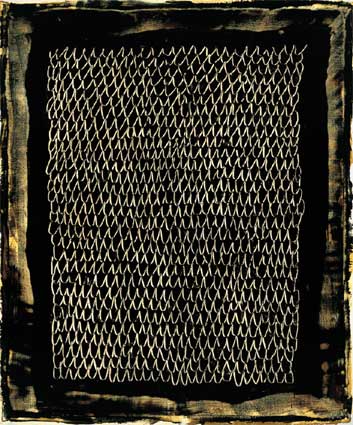
"La noche cíclica", por J.L. Borges (en memoria de Hernandez Pijuán)
Lo supieron los arduos alumnos de Pitágoras:
los astros y los hombres vuelven cíclicamente;
los átomos fatales repetirán la urgente
Afrodita de oro, los tebanos, las ágoras.
En edades futuras oprimirá el centauro
con el casco solípedo el pecho del lapita;
cuando Roma sea polvo, gemirá en la infinita
noche de su palacio fétido el minotauro.
Volverá toda noche de insomnio: minuciosa.
La mano que esto escribe renacerá del mismo
vientre. Férreos ejércitos construirán el abismo.
(David Hume de Edimburgo dijo la misma cosa).
No sé si volveremos en un ciclo segundo
como vuelven las cifras de una fracción periódica;
pero sé que una oscura rotación pitagórica
noche a noche me deja en un lugar del mundo
que es de los arrabales. Una esquina remota
que puede ser del Norte, del Sur o del Oeste,
pero que tiene siempre una tapia celeste,
una higuera sombría y una vereda rota.
Ahí está Buenos Aires. El tiempo que a los hombres
trae el amor o el oro, a mí apenas me deja
esta rosa apagada, esta vana madeja
de calles que repiten los pretéritos nombres
de mi sangre: Laprida, Cabrera, Soler, Suárez...
Nombres en que retumban (ya secretas) las dianas,
las repúblicas, los caballos y las mañanas,
las felices victorias, las muertes militares.
Las plazas agravadas por la noche sin dueño
son los patios profundos de un árido palacio
y las calles unánimes que engendran el espacio
son corredores de vago miedo y de sueño.
Vuelve la noche cóncava que descifró Anaxágoras;
vuelve a mi carne humana la eternidad constante
y el recuerdo ¿el proyecto? de un poema incesante:
«Lo supieron los arduos alumnos de Pitágoras...»
Joan Hernández Pijuán murió ayer a los 74 años de edad.
Hernández Pijuan, fue un creador de imágenes elementales con referencias a la naturaleza. En sus paisajes,Pijuán sintetiza el alma de estos espacios cultivados por el hombre a través de pequeños detalles que hablan de un árbol o un camino que sobresale sobre la planicie de un campo labrado.
La actividad artística de Pijuán evolucionó desde el expresionismo hacia una figuración geométrica. En 1959, formó el grupo Sílex con Carles Planell, Eduardo Alcoy, José María Rovira Brull y Lluís Terricabras. En 1981 fue nombrado catedrático de la Facultad de Bellas Artes de la Universidad de Barcelona, siendo decano de dicha facultad de 1992 a 1997. Ingresó en la Academia de San Fernando en 2000.
29 de diciembre de 2005
El tiempo cíclico (a propósito de lo mejor de 2005)
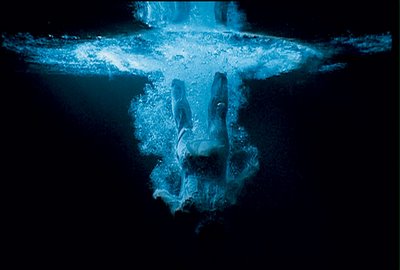
Termina 2005, y se publican las listas con lo mejor del año. Creo, como El Cultural de El Mundo, que "Las Pasiones", de Bill Viola, ha sido la mejor exposición.
Cada fin de año es idéntico al anterior porque nuestra incapacidad para asumir la muerte nos conduce a vivir de forma cíclica, no lineal. En tiempos de agnosticismo, una vida en línea recta se convierte en el peor de los laberintos, porque está abocada a la mayor de las incertidumbres.
Organizando el tiempo de forma cíclica jugamos con la posibilidad de comenzar de nuevo, intentando olvidar proyectos fallidos y recuerdos dolorosos. Clasificar nuestra experiencia en bucles melancólicos nos ilusiona con la sensación de que controlamos el tiempo y los recuerdos en mayor medida de lo que somos capaces de hacerlo.
El fin de año es, por tanto, momento de borrones y cuentas nuevas, de principios y finales, aunque casi siempre se trate de intentos fallidos, porque ni podemos administrar de forma precisa lo que almacena nuestro cerebro, ni somos capaces de adaptar el paso del tiempo al ritmo de nuestras intenciones.
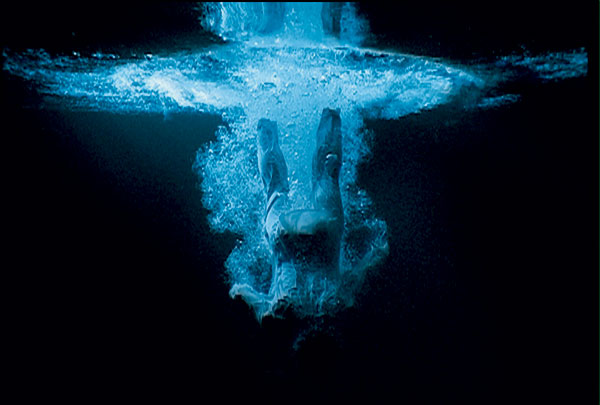
"Las pasiones", de Bill Viola tiene mucho que ver, a mi juicio, con esa percepción circular del tiempo, y con nuestro inútil esfuerzo por controlarlo.
Viola ha tratado de reflejar, según sus propias palabras, "el paso de una ola emocional a través de un ser humano", y a mi juicio lo consigue. Para lograr la conexión entre la obra y su espectador, el movimiento se ralentiza más allá de lo que somos capaces de percibir (hasta 300 fotogramas por segundo), haciendo que las emociones trasciendan su dimensión temporal.
El tiempo circular se presenta en "Las Pasiones" a través de la revisión en clave contemporánea de una temática clásica, y de la presencia de "arcos de intensidad" que alternan emociones contrapuestas (alegría y pena, cólera y miedo); pero, sobre todo, tiene que ver con la dolorosa experiencia de la muerte de un ser querido, y la evidencia, en ese momento, de que somos incapaces de controlar el tiempo de una vida que se va, arrastrando, con ella, parte de la nuestra (el padre de Viola falleció en 1998,cuando el artista comenzaba a concebir esta serie).
Cada fin de año es idéntico al anterior porque nuestra incapacidad para asumir la muerte nos conduce a vivir de forma cíclica, no lineal. En tiempos de agnosticismo, una vida en línea recta se convierte en el peor de los laberintos, porque está abocada a la mayor de las incertidumbres.
Organizando el tiempo de forma cíclica jugamos con la posibilidad de comenzar de nuevo, intentando olvidar proyectos fallidos y recuerdos dolorosos. Clasificar nuestra experiencia en bucles melancólicos nos ilusiona con la sensación de que controlamos el tiempo y los recuerdos en mayor medida de lo que somos capaces de hacerlo.
El fin de año es, por tanto, momento de borrones y cuentas nuevas, de principios y finales, aunque casi siempre se trate de intentos fallidos, porque ni podemos administrar de forma precisa lo que almacena nuestro cerebro, ni somos capaces de adaptar el paso del tiempo al ritmo de nuestras intenciones.
"Las pasiones", de Bill Viola tiene mucho que ver, a mi juicio, con esa percepción circular del tiempo, y con nuestro inútil esfuerzo por controlarlo.
Viola ha tratado de reflejar, según sus propias palabras, "el paso de una ola emocional a través de un ser humano", y a mi juicio lo consigue. Para lograr la conexión entre la obra y su espectador, el movimiento se ralentiza más allá de lo que somos capaces de percibir (hasta 300 fotogramas por segundo), haciendo que las emociones trasciendan su dimensión temporal.
El tiempo circular se presenta en "Las Pasiones" a través de la revisión en clave contemporánea de una temática clásica, y de la presencia de "arcos de intensidad" que alternan emociones contrapuestas (alegría y pena, cólera y miedo); pero, sobre todo, tiene que ver con la dolorosa experiencia de la muerte de un ser querido, y la evidencia, en ese momento, de que somos incapaces de controlar el tiempo de una vida que se va, arrastrando, con ella, parte de la nuestra (el padre de Viola falleció en 1998,cuando el artista comenzaba a concebir esta serie).
26 de diciembre de 2005
"The geometry of terror", por Juhanny Pallasmaa
THE MATHEMATICS OF THE STAGE
Developing as it does with the precision of mathematical thought, the Rear Window is probably Alfred Hitchcock"s most perfectly constructed film. It takes place during four days, from Wednesday to Saturday, and the events are filmed from the window of one apartment and mostly through the eyes of one person - the magazine photographer L.B. Jeffries (James Stewart), confined to a wheelchair with his leg in plaster.
Everything takes place in a block of apartments at 125 West 9th Street, Greenwich Village, at the south end of Manhattan, or more precisely within the buildings surrounding the courtyard. The address is made up as in reality this part of the street has no such number, because it changes into Christopher Street before reaching number 125. The fictional address is due to American law which requires that a film murder shall not take place at a real address. However, No. 125 Christopher Street was the address of the film murderer before the name was changed and in actual fact the model for the apartment block in the film was an actual building located at this address.
Most of the buildings around the courtyard are typical American tenements built in the grim "Federal brick" style. On the extreme right is a multi-storey plastered building, in front a four-storey brick house, directly in front a small, two storey building to the left of which is an alley leading to the street, and on the extreme left another red brick building that is so high that the upper storeys never appear in the film. The partly paved and planted courtyard is at different levels, and at the rear to the right is a part jutting out with a roof terrace joined to a glass fronted studio flat.
L.B. Jeffries"s home is a two-room apartment. The film takes place in the living room which has a kitchenette separated by cupboards. It contains a bay window overlooking the yard, a fireplace, a door to the bedroom, and a front door three steps up from the floor. The bedroom door is opened only once when the protagonist"s girlfriend Lisa goes in to change into her nightgown. This mysterious room, which is never shown to the audience, is a familiar Hitchcockian psychological theme - there is a locked room in the film Rebecca, for instance, the door of which is never opened. During the period of Jeff"s convalescence, a high bed has been moved into the bay, and the other furnishings have been moved to allow for his immobility and treatment.
"In my opinion the most fascinating films are those where everything happens in one single place, such as Hitchcock"s Rope or Rear Window, Marcel Carné"s Le Jour Se Léve and Michael Snow"s Wavelength,"2 said the American film director and researcher Peter Wollen in his lecture at the first Film and Architecture seminar in Helsinki in October 1996.
The extreme spatial restrictions of Rear Window - the film is seen from the perspective of a person bound to one spot and everything takes place within one huge set - was a stimulating challenge for Hitchcock: "It was a possibility of doing a purely cinematic film. You have an immobilised man looking out. That"s one part of the film. The second part shows what he sees and the third part shows how he reacts. This is actually the purest expression of a cinematic idea."
THE CHARACTERS IN THE FILM
Walter Benjamin"s description of the theatrical character of the townscape of Naples is an exact picture of the combined stage and auditorium in Rear Window: "Buildings are used as a popular stage. They are all divided into innumerable, simultaneously animated theatres. Balcony, courtyard, window, gateway, staircase, roof are at the same time stage and boxes."
The tenants observed through the windows of their apartments are like a collection of butterflies in glass-covered cases - the director even puts this idea into the mouth of the photographer, "they can ... watch me like a bug under glass, if they want to." The tenants form a cross section of New York"s colourful populace: a song writer composer, a young dancer keeping her figure in trim, a sculptress, a middle-aged spinster longing for male company, the passionate newlyweds, a childless couple doting over their little dog, a salesman and his invalid nagging wife, and the film"s protagonist, the magazine photographer L.B. Jeffries, Jeff, and his wealthy, fashion-conscious girlfriend - Lisa Fremont (Grace Kelly) who lives in the high rent district of Park Avenue and 63rd Street "and never wears the same dress twice". There"s a heat wave going on, everybody keeps their windows open, and to wile away the time the convalescent photographer in his wheelchair begins to observe what"s happening in the courtyard.
"The field of vision has always seemed to me comparable to the ground of archeological excavation," writes Paul Virilio. Despite being so contrived and restricted, the apartment block in the film is a rich excavation of city life in which the layers are only gradually exposed. The tenants form a closed community for whom the outside world appears distant; it is only seen in the film as a painted silhouette and a narrow view of the street. "What you see across the way is a group of little stories that ... mirror a small universe,"6 as Hitchcock said about the world in his movie. Lower middle class life was in any case familiar to him from his own childhood in the suburbs of London.
The tenants never encounter each other, except for a brief exchange of words between the sculptress and the salesman at the beginning of the film which he crudely terminates: "Why don"t you shut up." Although the tenants have outside friends, they remain strangers to each other. "You don"t know the meaning of the word neighbour," says the strangled dog"s owner about her neighbours at this most dramatic scene in the film. Not until the scream following the discovery of the strangled dog do they come into the courtyard space and look down upon the centre of attention; the darkened windows reveal the dog strangler and wife murderer withdrawn from the group. He can be seen smoking a glowing cigarette in his darkened apartment. The darkness of this scene is undoubtedly one of the finest of its type in the history of the cinema. In this scene the camera moves temporarily and unnoticed into the courtyard to view the characters from below, as a single wide frame shot, from the perspective of the strangled dog. This deviation brings about one of the most dramatic scenes in the film. "The size of the image is used for dramatic purposes,"7 says Hitchcock about his cinematic dramaturgy.
THE LOGIC OF TERROR
The suspense in the film is based on the irrefutable logic of terror. Hitchcock slowly awakens in the audience a stream of suspense which he dams until the final cataractous release. Hitchcock planned his film so precisely that after it had been edited, only a few dozen metres of film remained on the cutting room floor.
As is usual with an artistic masterpiece, Rear Window weaves innumerable details into a faultless fabric in which allusions and hints criss-cross unendingly in all directions. Every episode or line appears to contain meanings and allusions. Miss Torso (Georgine Darcy), the nickname given to the shapely dancer, intimates mutilation, the central theme of the film. The little dog is killed because "it knew too much", a natural allusion to the film Hitchcock directed twice (The Man Who Knew Too Much, 1934 and 1956). Hitchcock even wrote an enigmatic article about his wife Alma entitled "The Woman Who Knew Too Much".8 Even the words of the songs heard in the background always relate ambiguously to the scene. Colours, too, contain meanings: for example, Miss Lonelyhearts (Judith Evelyn) is coded in green; her dresses are always different shades of emerald green and there are no other green clothes in the film.
Rear Window is truly a masterpiece of artistic abridgement: its richness and logic are only revealed after seeing it several times. But great works always contain a great number of redundances, depths and levels. The narrative logic of the film, its architectural messages, role characterisations, atmospheres and secret hints, camera angles and shot compositions, space and image details, and words and music constitute a mosaic that builds up the suspense with the infallibility of the geometrist. The film ends like a geometrical exercise at school, q.e.d. - which was to be demonstrated. "Clarity, clarity, clarity, you cannot have blurred thinking in suspense,"9 as Hitchcock says.
THE SITUATIONALITY OF MEANING
Hitchcock stresses the importance of pictorial and material expression, to which he totally subjects the narrative dialogue: "Dialogue should simply be a sound among other sounds, just something that comes out of the mouths of people whose eyes tell the story in visual terms."10 Hitchcock"s interest is not so much in the stories in his films but "in the way they are told."
"The impact of the image is of the first importance in a medium that directs the concentration of the eye so that it cannot stray. In the theatre, the eye wanders, while the word commands. In the cinema, the audience is led wherever the director wishes."11
Hitchcock"s ability to reveal the hidden feelings and moods of the characters by a simple gesture, rhythm or camera angle frees the dialogue for its contrapunctual purpose. On top of an everyday pictorial narrative, lines are spoken that have quite surprising or absurd dimensions, like the insurance nurse-therapist Stella"s (Thelma Ritter) story of how she foresaw the Great Crash of "29 from the number of times her patient, the boss of General Motors, visited the toilet: "When General Motors has to go to the bathroom ten times a day, soon the whole nation is ready to let go," she remarks.
THE EXTRANEOUS AND THE CONTRADICTORY
The extraneousness of the events, their intermingling and occasional triviality - like the meaningless helicopter flying over the buildings at the beginning of the film, which hovers to gawk at the bathing beauties on the flat roof -increases the credibility and irrevocability of the main story, in much the same way as the mundane and incidental details in the epic works of the great painters of history. Tizian"s monumental painting Presentation of the Virgin brings a touch of ordinary life through irrelevant episodes: the countrywoman selling eggs, the boy playing with a dog and the mother with a child in her lap talking to a monk. A story achieves the aura of real life when it does not proceed too linearly and obviously; the individual will of the narrator and director controlling the events appears to simultaneously submit to the overriding power of destiny.
Fear and love are contradictory and mutually exclusive emotions. In Rear Window suspense and fear often develop alongside the love affairs; the scenes where Lisa and Jeff are kissing, the intimacy of the newlyweds behind the drawn blinds, the men fawning over Miss Torso, and the lovelorn Miss Lonelyhearts. Even the murderer is having an illicit love affair.
Alongside the yearning and problematics of love, there are powerful erotic and sexual suggestions and symbols, such as Lisa"s pining for love and Miss Torso"s erotic teasing, and on the other hand Jeff"s rebuffing of Lisa"s approaches compared to his obvious interest in observing the intimate life of the dancer from a distance. As regards Jeff, he has both phallic symbols (the telephoto camera) and manifestations of frigidity and impotency (a leg in plaster and immobility). Jeff"s rebuffing of Lisa and occasional rudeness is not explained by the difference in class or customs, as he would have it.
The events in the lives of the tenants develop independently of the main story, but occasionally the climaxes of these separate stories are connected, as for example Miss Lonelyhearts" preparations for suicide at the same time as Lisa faces a dangerous situation in the murderer"s apartment. Hitchcock creates a feeling of terror through well chosen scenes just when the mind is most receptive, such as when a bloodcurdling scream from the yard interrupts Lisa displaying her enticing lingerie, the murderer cleaning the butcher"s knife and little saw against the sound of children playing, or when Lisa is kissing Jeff whilst his mind is preoccupied with the significance of the murder weapons. The murderer"s gardening hobby also belongs to this series of contradictions. The occasional background sound of a soprano practicing simultaneously lulls the audience into a benign sense of security as well as a premonition of fear from the higher notes. "Emotion is an essential ingredient of suspense,"12 writes Hitchcock.
SPECTACLE
The lives of the tenants in Rear Window can be observed in the lit rooms behind uncurtained windows like separate films or TV programmes. Peeping into the apartments through the photographer"s long focus lens and binoculars is a bit like channel-swapping with a remote13; Lisa Fremont"s metaphors; "It"s opening night of the last depressing week of L.B. Jeffries in a cast", "I bought the whole house", and "The show"s over for tonight", as she pulls down the shades of the windows facing the courtyard in front of Jeff"s curious eyes, all indicate a show. "Preview of coming attractions," says Lisa as she flashes the overnight bag containing her nightgown, is also a reference to the cinema-like structure of the story. The transfer of the action from one window to another - as if moving from one screen to another - creates a comical effect, but also brings to mind René Magritte"s conceptual painting L"evidence éternelle, 1930, of a woman"s body painted in parts on five separate, superimposed canvases or the landscape variation of the same theme in Les profondeurs de la terre, 1930.
Actually, Jeff appears to create the story of the film in his own mind, as he interprets the meanings of the unrelated events he observes and almost directs how they will develop. The whole story might just be a dream or an illusion brought on by his immobility. He also cuts the film into montages by transferring his view (= camera"s view = spectator"s view) from one window and episode to the next and in selecting the image frames and distances with his own eyes through the alternative optics of the telephoto camera and binoculars. Jeff is thus simultaneously both the film"s director and spectator and Rear Window in its entirety is a metaphor and study in making and viewing a film.
THE REALISM OF THE SET
The apartments are like stages stacked one upon the other, like urn recesses in a columbarium, with no access to the normal anatomy of an apartment block, to staircases and corridors; only the flats of the salesman and Miss Lonelyhearts are connected to a corridor. The young man in the just rented flat on the left reopens the front door in order to carry his bride over the threshold, but where the door leads to remains unclear. The block of apartments in the film is like a tree lifted from its roots without access to the ground water.
Neither are the plans of the apartments "real", as they have been flattened against their facades so everything can be seen through the camera in Jeff"s room. For example, the flats of the Thorwalds and Miss Lonelyhearts are unorthodoxly approached through a kitchen. And where is the murderer"s (Raymond Burr) bathroom located, the walls of which he is shown to be washing?
The apartment block in Hitchcock"s film appears to have been built by man into a mountain, a canyon, the excavated flats of which apparently lack another side, despite the fact that the audience is shown a narrow view of a rear street and a restaurant located at the opening between the buildings. The courtyard and the apartments facing it form a huge stage surrounded by what appears to be a hidden back stage in the darkness of which the occupants move from the street to their flats.
THE PSYCHICAL MAP OF THE FILM
Peter Wollen sees in general the series of places in a film as its structural elements: "Building up the story of a film ... also means drawing a psychical map. In watching a film we form in our minds diagrams of the relationship between the different places on which the film is constructed, and of those routes the characters use in or between these places."
The routes used by the characters in Rear Window are almost completely in the unknown back stage, neither can the audience form the kind of psychical map Wollen spoke of. The exit from Jeff"s flat to the street is somewhere to the left behind the audience. The murderer creeping up the stairs to Jeff"s flat brings the unfamiliar rear of the building into the audience"s imagination and it is just the unfamiliar rear that maximises the threat: at this stage the threat is not just the rather pathetic Mr Thorwald, but the labyrinthine unfamiliarity of the building itself. The true identities of the tenants, their invisible intimate life and subconsciousness, appear to be concealed in this back stage. The threat is not contained in what is shown, but in what is not shown. The terror is not in the scene projected on the screen, but in the minds of the audience.
The wheelchair-bound photographer has to leave his front door unlatched so his girlfriend, nurse and detective buddy can enter; the three steps leading to the door prevent the wheelchair patient from opening it. The knowledge that the door is unlocked increases the threat of the footsteps creeping up the stairs. An extra dimension of terror is provided by the narrow strip of light under the door with its ominous guillotine-like shape. When the passage lights suddenly go out as the footsteps reach the door, it"s like the blade falling; the startling of the audience when the lights go out further increases the intensity of terror.
Hitchcock says about his special cinematic field, fear: "My special field (which I have split) into two categories - terror and suspense ... terror is induced by surprise, suspense by forewarning." He went on to define the difference between the two: "Suspense is more enjoyable than terror, actually, because it is a continuing experience and attains a peak crescendo fashion; while terror, to be truly effective, must come all at once, like a bolt of lightening, and is more difficult, therefore, to savour."
THE GEOMETRY OF VOYEURISM
The film tells the story of a murder and its exposure, but its central philosophical theme is actually the voyeurist gaze. The complicated relationship between the watcher and the watched in Rear Window brings to mind Velazquez"s painting Las Meninas. The location and role of the watcher have been the subject of philosophical contemplation in both.
"We"re all voyeurs to some extent, if only when we see an intimate film. And James Stewart is exactly in the position of a spectator looking at a movie," François Truffaut notes when interviewing Hitchcock about his intentions in Rear Window. Jeff"s voyeurism is not, however, a sexual perversion in its normal meaning, but more the professional curiosity of a photographer.
Although the concept of private life would appear to be quite self evident, the 2800-page A History of Private Life shows that it has both an interesting history and a multiplicity of dimensions. In a drawing in his collection The Art of Living19 published in 1945, the well-known cartoonist Saul Steinberg shows a set-up similar to that in the film of a dissected apartment block exposing the private lives of its tenants. But even Steinberg had his predecessor; as far back as 1847 Le Magazine pittoresque"s cartoonist depicted in his Tableaux de Paris drawing different life styles and social classes within the framework of a single building.
The voyeuristic stage and private performances of Rear Window are also connected to the private peep shows, the "tableaux vivant", of Parisian brothels in the last century. "That"s a secret, private world you"re looking at out there. People do a lot of things in private that they couldn"t possibly explain in public," says Detective Doyle (Wendell Corey) to Jeff.
By way of introduction to the voyeurist content of the film, the bamboo shades rise slowly underneath the credits, like a view opening through drowsily raised eyelids; this is also a reference to the gradual awakening of the unsuspecting sleeping photographer to the reality of murder. The shades are likewise a metaphor for the stage curtain; as they rise they reveal the courtyard, the scene of the unfolding drama. This introduction to the theme of voyeurism is also present in the hovering helicopter ogling at the scantily dressed girls.
Throughout the film, the camera - the voyeuristic eye - is bound to the wheelchair in the photographer"s room, apart from the climax when the murderer pushes his exposer out of the window - it then moves outside along with the photographer. The camera also pops outside during the scene of the strangled dog, but the spectator hardly realises that it has momentarily strayed into the courtyard.
In analysing Descartes" writings dealing with reading, the philosopher David Michael Levin uses the term "bodiless reader". The protagonist in Rear Window and the spectator are likewise bodiless observers. Jeff"s immobility eliminates the physicality of experience and transforms it into something purely visual; the eye subjects the other senses. Scratching his itchy leg under the plaster with a back scratcher epitomises the loss of Jeff"s sense of movement and touch. His complete reliance on his sense of vision represents the spectator, alone and bound to his chair in the darkness of the cinema. It is just the spectator"s immobility that lulls him into a regressive, dreamlike state.21
THE MORALITY OF VOYEURISM
"The New York State sentence for a Peeping Tom is six months in the work house ... You know, in the old days, they used to put your eyes out with a red-hot poker," warns Stella. "If you could only see yourself [with those binoculars] ... it"s diseased," Lisa scolds and comments that we are turning into "a race of peepers". "What people ought to do is get outside their own house and look in for a change," says Stella warning Jeff of the dangers of peeping. At the end of the film the murderer literally fulfills the nurse"s idea by pushing Jeff out of the window - to see the inside of his flat from the outside for the first time.
Jeff ponders whether it is ethically acceptable to spy on people through his long-focus lens. "I"m not much on rear-window ethics," replies Lisa to his semi-rhetorical question. At first both Lisa and Stella disapprove of Jeff"s snooping ("window shopper," accuses Stella), but later become keen peepers themselves. The murderer only realises he is being watched when, following Lisa"s worried hand movements, he notices the position of his observer. At this dramatic moment Jeff changes from being the surveillant to being the surveilled, and all of a sudden his former victim gains the upper hand. In trying to delay the approach of the murderer, Jeff blinds him with flashbulbs. In the eyes of the murderer, his field of vision is toned red - showing his temporary blindness and increasing rage. In this scene the contrast between darkness and light assumes an obvious symbolic meaning.
On two occasions Jeff"s suspicions about the crime appear to be unfounded. The main characters in the film, as well as the audience, are temporarily disappointed that no murder had been committed after all. This feeling of disappointment induces a sense of guilt which gets the audience even more closely involved in the course of the story. Whether in fact a murder has been committed is of importance also from the point of view of the moral acceptance of peeping. "I wonder if it"s ethical [to watch a man], even if you prove that he didn"t commit a crime?" muses Jeff.
In his book Downcast Eyes, the philosopher Martin Jay brings out Freud"s views on the relationship between the desire to know, sexuality and voyeurism: "Freud came to believe that the very desire to know (Wisstrieb), rather than being innocent, was itself ultimately derived from an infantile desire to see, which had sexual origins. Sexuality, mastery and vision were thus intricately intertwined in ways that could produce problematic as well as "healthy" effects. Infantile scopophilia (Schaulust) could result in adult voyeurism or other perverse disorders much as exhibitionism and scopophobia (the fear of being seen).".
SURVEILLANCE AND THE SURVEILLED: THE PANOPTICON
But Rear Window also philosophises about the distance between the surveillant and surveilled. In the film, the latter are always distanced by the courtyard or some technical gadget. Distance gives to the experience a sense of helplessness and loneliness, as well as a subconscious feeling of guilt associated with watching. The spectator also sees himself as a Peeping Tom. The voyeuristic effect is created just in the one-sidedness of surveilling and because the object is unaware of being observed. The fact that the objects of Jeff's = the spectator's interest never look back, creates a voyeuristic experience and turns the spectator into a Peeping Tom whose feeling of guilt also makes him feel he is being scrutinised.
There is an important psychological difference between the events in Jeff's room and those in the apartments opposite: the former are by nature theatre, whereas the latter distant episodes are cinema. Walter Benjamin discussed the psychological difference between these two art forms in one of his best known works: "The artistic performance of a stage actor is definitely presented to the public by the actor in person; that of the screen actor, however, is presented by a camera, with a twofold consequence. ... The camera that presents the performance of the film actor to the public need not respect the performance as an integral whole." The audience experience the events in Jeff's room as a continuum, but those in the apartments opposite as unrelated fragments.
Another element in the film is the duality of the voyeuristic gaze; simultaneous spectacle and surveillance. "Our society is not one of spectacle but of surveillance ... We are neither in the amphitheatre, nor on the stage, but in the panoptic machine," concluded Foucault. In his book Discipline and Punish, Foucault uses Jeremy Bentham's Panopticon as the main theoretical means for explaining how man became the object of surveillance in the institutional control, scientific research and behavioral experiments of modern society. Bentham's Panopticon had its predecessor in Louis Le Vau's menagerie at Versailles. At the centre of the building was an octagonal pavilion containing the king's salon, on every side of which large windows looked out onto seven cages containing different species of animals - the eighth side was reserved for the entrance. Similarly, in the film's menagerie there are seven flats being scrutinised and an alley from the street to the courtyard! But Foucault perhaps dismissed the possibility of simultaneous spectacle and surveillance, which is just what Hitchcock's film is all about. Vincenzo Scamozzi's design for the stage of Andrea Palladio's Teatro Olimpico, Vicenza (1584), a vista of seven different streets, is likewise reminiscent of the panopticon as well as the set in Rear Window where seven different flats can be observed from Jeff's room.
The film set lifts peeping to the third potential; 1) the movie camera watches 2) the photographer watching through his telephoto camera, and 3) the audience in turn watches the events through the illusion projected on the screen. Rear Window is a heightened central perspective film, which brings to mind the perspective drawing device used by the Renaissance artist in one engraving by Dürer. The point of projection of the central perspective, Jeff, is simultaneously a member of the cinema audience and the first person narrator of the story. In using a perspective device an artist normally requires an assistant, just like Lisa, Stella and Doyle function as Jeff's legs in his investigations.
CAMERA OBSCURA AND THE STAGE AS A MACHINE
The photographer tied to his room becomes both camera and projector, as well as a camera obscura representing his own room.25 "Can I borrow your portable keyhole," asks Stella taking Jeff's binoculars. The Peeping Tom is basically the photographer's room, the spatial location of which in the apartment block complex enables the ensuing situation. The set, made under the supervision of Joseph MacMillan Johnson and Hal Pereira - the Rear Window's panopticon - is perfect as the logical architectonic projection of the story.
The location of the film's action, with its courtyard, gardens, streets, cars and thunder showers, was made in Paramount's largest studio, Stage 18, which measured 55 x 30 metres and was 12 metres high.26 It was the largest set ever built for Paramount, and included 31 flats of which 12 were fully furnished. Hitchcock himself supervised the construction which took six weeks. The structures contained 70 windows and doors, and the walls in Jeff's flat were removable to allow for all possible camera angles. The lowest level of the courtyard was built below the studio floor. Filming the events in the individual flats and all the small objects (the ring, pearl necklace, the name Eagle Road Laundry on the murderer's laundry parcel - the word laundry alludes to the French mass-murderer Henri Désiré Landru, upon whom Chaplin had based his film Monsieur Verdoux eight years earlier in 194727) would not have been possible in natural light. The day and night lighting for this colossal set required all of Paramount's equipment.
As much as the narrative itself, the structure of the film is composed of the spatial relationships and geometry of the tenants' flats, the courtyard, the alley to the street, the street itself with the restaurant on the opposite side and the view above of the south town silhouette. The apartment block is a stage machine which produces the narrative according to the script. The set is thus a kind of variation on the theme of the promenade architectural - architecture subordinated to a linearly advancing story. It is also the architecture of surveillance and domination according to Michel Foucault's well-known analysis; his picture of the cells in the ideal panopticon-prison corresponds exactly to Hitchcock's cinematic panopticon: "They are like so many cages, so many small theatres, in which each actor is alone, perfectly individualised and constantly visible. ... Each individual, in his place, is securely confined to a cell from where he can be seen from the front by the supervisor, but the side walls prevent him from coming into contact with his companions. He is seen, but be does not see; he is the object of information, never a subject in communication."28 The scene in which the naked dancer is in the bathroom and the murderer in the corridor leading to his apartment, separated by only the thickness of the wall, are the solitary cells in Rear Window's panopticon.
PAINTING THEMES IN REAR WINDOW
Edward Hopper's painting Night Windows (1928), the theme of which is an illuminated room in the house opposite, is like something out of the voyeurist world of Rear Window. Miss Lonelyhearts, waiting for her imaginary companion or contemplating suicide, is also like one of Hopper's paintings - for example, Automat (1927) - lonely women sitting in a café; even the green colour of her dress appears in Hopper's paintings. It is evident that Hitchcock was fully acquainted with the works of Hopper for he had Bates' house in Psycho (1960) built according to the artist's painting House by the Railway (1923).
Many of Hopper's other paintings are also related to the voyeurist theme of the film. In Night Hawks (1942) and New York Office (1962) the subjects of external scrutiny are a night bar and an office; in Apartment Houses (1923) and Room in New York (1932) the intimate interiors of private homes. Girlie Show (1941) draws directly on the sexual content of voyeurism, whereas in Eleven A.M. (1926) a naked woman is staring fixedly at the courtyard from an open window. Finally, in Office in a Small Town (1953), a lonely man in an office appears to be surveilling and commanding his immediate surroundings in much the same way as L.B. Jeffries in the film.
A figure looking out of a window is a familiar motif in painting since the Renaissance. However, the spectator, the artist, is always in the same space as his model and with his or her approval. On the other hand, looking through a window into a room from the outside only became popular in our century. By its very nature a window is meant for looking out of, not the reverse. A view of the inside from the outside confuses the ontology of the window and makes it a voyeuristic instrument, and the object is no longer conscious of being under external scrutiny.
HITCHCOCK AND DUCHAMP
The voyeurism of Rear Window and the boundary between the private and public domains create a link to some of the central themes of modern art. The best known work dealing with the nature of voyeurism is undoubtedly Marcel Duchamp's Étant donnés: 1. La chute d'eau, 2. Le gaz d'éclairage (1944-66), which the artist was making at the same time as Hitchcock was making his film. Duchamp made his final work in complete secrecy as it was believed he had given up art altogether. Both the film and Duchamp's enigmatic work are studies in fixed eye central perspective, the interaction of intimate privacy and voyeurist gaze, and the intertwining of eroticism and violence. An intimate event becomes public once a district attorney becomes involved, in other words when a crime has been committed under the veil of privacy.
In Duchamp's three-dimensional composition, a woman lying with her legs apart upon a reedy shore, a gas lamp raised in her left hand, is observed through two holes in an ancient Spanish timber door. In the background sparkles an electrically-operated illusionary waterfall. The young, fair-haired female figure's hairless pubes are indecently exposed directly in front of the viewer's eye in the dazzling light of a diorama. The perspective diorama composition suggests a narrative of sexual perversions or violence, but the event remains unexplained.29 The way in which the spectator's mind seeks a causal logic from the hints in Duchamp's construction, is reminiscent of the way Jeff perceives the logic of the series of episodes he sees from his window. Duchamp's work arouses a simultaneous feeling of scopophilic excitement and voyeuristic shame. The incident in Hitchcock's film is exposed as a crime, but that in Duchamp's work remains for ever enigmatic; is this Duchamp's perfect crime? But as Octavio Paz notes in his essay on Duchamp: "We pass from voyeurism to clairvoyance."30 Likewise in Rear Window the voyeurist gaze ultimately leads to clairvoyance and the purification that characterises a work of art.
THE ROLES OF OBJECTS
The language of objects plays a central role in this as in all Hitchcock's films. "I make it a rule to exploit elements that are connected with a character or a location; I would feel that I"d been remiss if I hadn't made maximum use of those elements,"38 says Hitchcock about the importance of location and objects in his films.
The photographer's camera naturally plays a fetishistic leading role. The objects in Jeff's room offer clues to why he is in a wheelchair with his leg in plaster; the photographs indicate his profession, the close-ups of racing cars the dangers he loves, and the shattered camera the accident on his last assignment. The camera is Jeff's tool and livelihood, but during the film it changes into a means for observing, warning and investigating, and - ultimately - a weapon of self-defence. The slide photographs of the garden - which the murderer has used for burying something - are another dimension of the camera.
In the murderer's apartment the murder weapons (the knife and saw), the aluminium jewellery sample case used to convey the dismembered body, the rope-bound trunk containing the wife's belongings (Jeff and his assistants, as well as the audience, are actually temporarily led to believe that the trunk contains bits of the body; "He better get that trunk out of there before it starts to leak," says Stella) represent violence. The rope conjures up an unpleasant association with hanging in the spectator's mind. The murdered woman's ring and handbag also play a role in the story. Lisa slipping the ring onto her own finger has a double meaning in its reference to her ardent desire to marry Jeff. Lisa's fashionable clothes - particularly her overtly provocative diaphanous nightgown - and her fetishism for expensive objects related to her value world creates a powerful symbolic tension compared to the mundane lower middle class existence of Jeff and his fellow tenants.
The apparent contradiction between the wealth reflected by Lisa's family and profession and the photographer's impoverishment ("I have never more than a week"s salary in the bank.") is continuously emphasised by Jeff. But in his book Techniques of the Observer, Jonathan Crary connects photography and money in a way that eliminates any superficial class differences. "Photography and money become homologous forms of social power in the nineteenth century. They are equally totalizing systems for binding and unifying all subjects within a single global network of valuation and desire. ... Both are magical forms that establish a new set of abstract relations between individuals and things and impose those relations as the real. It is through the distinct but interpenetrating economies of money and photography that a whole social world is represented and constituted exclusively as signs."32 There is thus no real contradiction between the worlds of Lisa and Jeff - from the beginning they both belong to the same power elite.
The characters in the film are also treated as objects. The dancer and the ideal of perfection that Lisa represents are personifications of magazine femininity and erotic desire. In his immobility and helplessness Jeff is also transformed into an object, which the others have to move and care for. In the end even the figure of the murderer loses his vileness and repugnance when revealed as the pitiful product of a cruel fate he has only tried to conceal. Due to their prototypicality all the characters in the film are representatives of their own genre - models and concepts.
FICTION AND REALITY
In Hitchcock's film the audience is so gripped by suspense that the obvious theatrical unreality or architectonic incredibility of the buildings can no longer release or moderate the reality of terror. Architecture has lost its normal meaning and has submitted to terror.
On the other hand, the incredulous staged background can also be seen as a striving for absolute truthfulness. At the end of the film the police arrive in Jeff's room only a few seconds after being alerted, but in fact the Sixth Precinct of the Manhattan police is actually in Tenth Street, just opposite the entrance to Jeff's flat. The Hotel Albert, where Jeff lures the murderer, was on the corner of Tenth Street and University Place when the film was being made - nowadays it has been refurbished as an apartment block.
The script of Rear Window was based on Cornell Woolrich's short story of the same name, to which Hitchcock added some authentic material about two macabre crimes - thus the film's fictional crime acquires a realism from two real-life cases. In the case of Patrick Mahon, he murdered a woman, dismembered her body and threw the bits one by one from a train window, except the head which he burnt. In the case of Dr Crippen, he murdered his wife and also dismembered her body. For a long time he managed to delude friends curious about his wife's disappearance by telling them she had gone to California. He was recognised whilst making his escape by steamer, in the company of his mistress disguised as a boy, on the basis of his wig and lower set of false teeth.
HUMOUR AND FANTASIES
It is characteristic of Hitchcock to raise the threshold of an audience's suspense by creating a smoke screen of macabre humour: "And for me, "suspense" doesn't have any value if it's not balanced by humour."34 Innocent macabre comments by Jeff and Stella inveigle the audience into imagining that a woman's body has been dismembered in one of the flats and the bits carried away in the sample case: "That would be a terrible job to tackle, just how would you start to cut up a human body?", "Just where do you suppose he cut her up? "Course, the bathtub! That's the only place where he could have washed away the blood", "In a job like that it must have splattered a lot," and "The only way anybody could get my wedding ring would be to chop off my finger".
The film does not show the murder or the dismemberment, not even a drop of blood, but they appear even more realistically in the minds of the audience. The nocturnal moment when the murder takes place is marked by the woman's muffled shriek and the sound of a glass breaking, but at this stage the audience is not ready to appreciate the meaning of these almost imperceptible sounds; this they acquire later on when the audience returns in its mind to the chronology and logic of the drama. The night thunder that accompanies these sounds probably gives the audience a feeling that something tragic has occurred.
The events which the audience imagines and its feelings about them are more impressionable. "I have always felt that you should do the minimum on the screen to get the maximum audience effect,"35 as Hitchcock says expressing his principle of cinematic minimalism.
At the end of the film the audience is forced to imagine that part of the woman's body was buried in the flowerbed, after hearing that Thorwald had dug it up and put it in the victim"s hat box; this episode brings to mind the Mahon case where the murderer also had trouble disposing of the victim's head.
During the film the spectators and actors of the spectacle change places on two occasions: Lisa moves from the auditorium to the stage, ie, the murderer's flat, and the murderer to Jeff's flat, ie, the auditorium. But the murderer also steps into the domain of the audience: Thorwald's arrival takes place quite clearly behind the vulnerable and unprotected back of the audience. The traditional theatre convention is that the spectator is inviolable, but when at the end of the film he is violently attacked, the psychological security created by the theatre illusion is shattered.
THE REALISM OF DREAMS
In his films Hitchcock reveals that behind everyday reality there is another reality. As he says: "Things are not as they would appear to be."
Any object or place becomes horrifying and unreal when we are capable of seeing through normal realism; beyond realism there is always surrealism. Subconscious, forgotten and rejected images seep through the ordinary consciousness dominated by the superego; without noticing it, our brains and nervous systems chart the dangers lurking in the unfamiliar. Even the faces of our mothers are transformed into frightening eroded landscapes if we stare so long that their familiar and loved features lose their ordinary meanings. In Hitchcock's films it is just the wavering between ordinary consciousness and dreams that predominates, the unreality of reality and the reality of unreality.
"For a director who bothers to really open his eyes, all the elements in our lives contain something make-believe,"37 wrote Jean Renoir in his autobiography. This becomes particularly clear when we watch Alfred Hitchcock's Rear Window.
The film is a kind of conscious dream. But even the artistic stages of architecture are always something other than the total of their material structures. Even these are primarily mental spaces, architectural representations, and images of the perfect life. Architecture, too, leads our imagination to another reality.
Developing as it does with the precision of mathematical thought, the Rear Window is probably Alfred Hitchcock"s most perfectly constructed film. It takes place during four days, from Wednesday to Saturday, and the events are filmed from the window of one apartment and mostly through the eyes of one person - the magazine photographer L.B. Jeffries (James Stewart), confined to a wheelchair with his leg in plaster.

Everything takes place in a block of apartments at 125 West 9th Street, Greenwich Village, at the south end of Manhattan, or more precisely within the buildings surrounding the courtyard. The address is made up as in reality this part of the street has no such number, because it changes into Christopher Street before reaching number 125. The fictional address is due to American law which requires that a film murder shall not take place at a real address. However, No. 125 Christopher Street was the address of the film murderer before the name was changed and in actual fact the model for the apartment block in the film was an actual building located at this address.
Most of the buildings around the courtyard are typical American tenements built in the grim "Federal brick" style. On the extreme right is a multi-storey plastered building, in front a four-storey brick house, directly in front a small, two storey building to the left of which is an alley leading to the street, and on the extreme left another red brick building that is so high that the upper storeys never appear in the film. The partly paved and planted courtyard is at different levels, and at the rear to the right is a part jutting out with a roof terrace joined to a glass fronted studio flat.
L.B. Jeffries"s home is a two-room apartment. The film takes place in the living room which has a kitchenette separated by cupboards. It contains a bay window overlooking the yard, a fireplace, a door to the bedroom, and a front door three steps up from the floor. The bedroom door is opened only once when the protagonist"s girlfriend Lisa goes in to change into her nightgown. This mysterious room, which is never shown to the audience, is a familiar Hitchcockian psychological theme - there is a locked room in the film Rebecca, for instance, the door of which is never opened. During the period of Jeff"s convalescence, a high bed has been moved into the bay, and the other furnishings have been moved to allow for his immobility and treatment.
"In my opinion the most fascinating films are those where everything happens in one single place, such as Hitchcock"s Rope or Rear Window, Marcel Carné"s Le Jour Se Léve and Michael Snow"s Wavelength,"2 said the American film director and researcher Peter Wollen in his lecture at the first Film and Architecture seminar in Helsinki in October 1996.
The extreme spatial restrictions of Rear Window - the film is seen from the perspective of a person bound to one spot and everything takes place within one huge set - was a stimulating challenge for Hitchcock: "It was a possibility of doing a purely cinematic film. You have an immobilised man looking out. That"s one part of the film. The second part shows what he sees and the third part shows how he reacts. This is actually the purest expression of a cinematic idea."
THE CHARACTERS IN THE FILM
Walter Benjamin"s description of the theatrical character of the townscape of Naples is an exact picture of the combined stage and auditorium in Rear Window: "Buildings are used as a popular stage. They are all divided into innumerable, simultaneously animated theatres. Balcony, courtyard, window, gateway, staircase, roof are at the same time stage and boxes."
The tenants observed through the windows of their apartments are like a collection of butterflies in glass-covered cases - the director even puts this idea into the mouth of the photographer, "they can ... watch me like a bug under glass, if they want to." The tenants form a cross section of New York"s colourful populace: a song writer composer, a young dancer keeping her figure in trim, a sculptress, a middle-aged spinster longing for male company, the passionate newlyweds, a childless couple doting over their little dog, a salesman and his invalid nagging wife, and the film"s protagonist, the magazine photographer L.B. Jeffries, Jeff, and his wealthy, fashion-conscious girlfriend - Lisa Fremont (Grace Kelly) who lives in the high rent district of Park Avenue and 63rd Street "and never wears the same dress twice". There"s a heat wave going on, everybody keeps their windows open, and to wile away the time the convalescent photographer in his wheelchair begins to observe what"s happening in the courtyard.
"The field of vision has always seemed to me comparable to the ground of archeological excavation," writes Paul Virilio. Despite being so contrived and restricted, the apartment block in the film is a rich excavation of city life in which the layers are only gradually exposed. The tenants form a closed community for whom the outside world appears distant; it is only seen in the film as a painted silhouette and a narrow view of the street. "What you see across the way is a group of little stories that ... mirror a small universe,"6 as Hitchcock said about the world in his movie. Lower middle class life was in any case familiar to him from his own childhood in the suburbs of London.
The tenants never encounter each other, except for a brief exchange of words between the sculptress and the salesman at the beginning of the film which he crudely terminates: "Why don"t you shut up." Although the tenants have outside friends, they remain strangers to each other. "You don"t know the meaning of the word neighbour," says the strangled dog"s owner about her neighbours at this most dramatic scene in the film. Not until the scream following the discovery of the strangled dog do they come into the courtyard space and look down upon the centre of attention; the darkened windows reveal the dog strangler and wife murderer withdrawn from the group. He can be seen smoking a glowing cigarette in his darkened apartment. The darkness of this scene is undoubtedly one of the finest of its type in the history of the cinema. In this scene the camera moves temporarily and unnoticed into the courtyard to view the characters from below, as a single wide frame shot, from the perspective of the strangled dog. This deviation brings about one of the most dramatic scenes in the film. "The size of the image is used for dramatic purposes,"7 says Hitchcock about his cinematic dramaturgy.
THE LOGIC OF TERROR
The suspense in the film is based on the irrefutable logic of terror. Hitchcock slowly awakens in the audience a stream of suspense which he dams until the final cataractous release. Hitchcock planned his film so precisely that after it had been edited, only a few dozen metres of film remained on the cutting room floor.
As is usual with an artistic masterpiece, Rear Window weaves innumerable details into a faultless fabric in which allusions and hints criss-cross unendingly in all directions. Every episode or line appears to contain meanings and allusions. Miss Torso (Georgine Darcy), the nickname given to the shapely dancer, intimates mutilation, the central theme of the film. The little dog is killed because "it knew too much", a natural allusion to the film Hitchcock directed twice (The Man Who Knew Too Much, 1934 and 1956). Hitchcock even wrote an enigmatic article about his wife Alma entitled "The Woman Who Knew Too Much".8 Even the words of the songs heard in the background always relate ambiguously to the scene. Colours, too, contain meanings: for example, Miss Lonelyhearts (Judith Evelyn) is coded in green; her dresses are always different shades of emerald green and there are no other green clothes in the film.
Rear Window is truly a masterpiece of artistic abridgement: its richness and logic are only revealed after seeing it several times. But great works always contain a great number of redundances, depths and levels. The narrative logic of the film, its architectural messages, role characterisations, atmospheres and secret hints, camera angles and shot compositions, space and image details, and words and music constitute a mosaic that builds up the suspense with the infallibility of the geometrist. The film ends like a geometrical exercise at school, q.e.d. - which was to be demonstrated. "Clarity, clarity, clarity, you cannot have blurred thinking in suspense,"9 as Hitchcock says.
THE SITUATIONALITY OF MEANING
Hitchcock stresses the importance of pictorial and material expression, to which he totally subjects the narrative dialogue: "Dialogue should simply be a sound among other sounds, just something that comes out of the mouths of people whose eyes tell the story in visual terms."10 Hitchcock"s interest is not so much in the stories in his films but "in the way they are told."
"The impact of the image is of the first importance in a medium that directs the concentration of the eye so that it cannot stray. In the theatre, the eye wanders, while the word commands. In the cinema, the audience is led wherever the director wishes."11
Hitchcock"s ability to reveal the hidden feelings and moods of the characters by a simple gesture, rhythm or camera angle frees the dialogue for its contrapunctual purpose. On top of an everyday pictorial narrative, lines are spoken that have quite surprising or absurd dimensions, like the insurance nurse-therapist Stella"s (Thelma Ritter) story of how she foresaw the Great Crash of "29 from the number of times her patient, the boss of General Motors, visited the toilet: "When General Motors has to go to the bathroom ten times a day, soon the whole nation is ready to let go," she remarks.
THE EXTRANEOUS AND THE CONTRADICTORY
The extraneousness of the events, their intermingling and occasional triviality - like the meaningless helicopter flying over the buildings at the beginning of the film, which hovers to gawk at the bathing beauties on the flat roof -increases the credibility and irrevocability of the main story, in much the same way as the mundane and incidental details in the epic works of the great painters of history. Tizian"s monumental painting Presentation of the Virgin brings a touch of ordinary life through irrelevant episodes: the countrywoman selling eggs, the boy playing with a dog and the mother with a child in her lap talking to a monk. A story achieves the aura of real life when it does not proceed too linearly and obviously; the individual will of the narrator and director controlling the events appears to simultaneously submit to the overriding power of destiny.
Fear and love are contradictory and mutually exclusive emotions. In Rear Window suspense and fear often develop alongside the love affairs; the scenes where Lisa and Jeff are kissing, the intimacy of the newlyweds behind the drawn blinds, the men fawning over Miss Torso, and the lovelorn Miss Lonelyhearts. Even the murderer is having an illicit love affair.
Alongside the yearning and problematics of love, there are powerful erotic and sexual suggestions and symbols, such as Lisa"s pining for love and Miss Torso"s erotic teasing, and on the other hand Jeff"s rebuffing of Lisa"s approaches compared to his obvious interest in observing the intimate life of the dancer from a distance. As regards Jeff, he has both phallic symbols (the telephoto camera) and manifestations of frigidity and impotency (a leg in plaster and immobility). Jeff"s rebuffing of Lisa and occasional rudeness is not explained by the difference in class or customs, as he would have it.
The events in the lives of the tenants develop independently of the main story, but occasionally the climaxes of these separate stories are connected, as for example Miss Lonelyhearts" preparations for suicide at the same time as Lisa faces a dangerous situation in the murderer"s apartment. Hitchcock creates a feeling of terror through well chosen scenes just when the mind is most receptive, such as when a bloodcurdling scream from the yard interrupts Lisa displaying her enticing lingerie, the murderer cleaning the butcher"s knife and little saw against the sound of children playing, or when Lisa is kissing Jeff whilst his mind is preoccupied with the significance of the murder weapons. The murderer"s gardening hobby also belongs to this series of contradictions. The occasional background sound of a soprano practicing simultaneously lulls the audience into a benign sense of security as well as a premonition of fear from the higher notes. "Emotion is an essential ingredient of suspense,"12 writes Hitchcock.
SPECTACLE
The lives of the tenants in Rear Window can be observed in the lit rooms behind uncurtained windows like separate films or TV programmes. Peeping into the apartments through the photographer"s long focus lens and binoculars is a bit like channel-swapping with a remote13; Lisa Fremont"s metaphors; "It"s opening night of the last depressing week of L.B. Jeffries in a cast", "I bought the whole house", and "The show"s over for tonight", as she pulls down the shades of the windows facing the courtyard in front of Jeff"s curious eyes, all indicate a show. "Preview of coming attractions," says Lisa as she flashes the overnight bag containing her nightgown, is also a reference to the cinema-like structure of the story. The transfer of the action from one window to another - as if moving from one screen to another - creates a comical effect, but also brings to mind René Magritte"s conceptual painting L"evidence éternelle, 1930, of a woman"s body painted in parts on five separate, superimposed canvases or the landscape variation of the same theme in Les profondeurs de la terre, 1930.
Actually, Jeff appears to create the story of the film in his own mind, as he interprets the meanings of the unrelated events he observes and almost directs how they will develop. The whole story might just be a dream or an illusion brought on by his immobility. He also cuts the film into montages by transferring his view (= camera"s view = spectator"s view) from one window and episode to the next and in selecting the image frames and distances with his own eyes through the alternative optics of the telephoto camera and binoculars. Jeff is thus simultaneously both the film"s director and spectator and Rear Window in its entirety is a metaphor and study in making and viewing a film.
THE REALISM OF THE SET
The apartments are like stages stacked one upon the other, like urn recesses in a columbarium, with no access to the normal anatomy of an apartment block, to staircases and corridors; only the flats of the salesman and Miss Lonelyhearts are connected to a corridor. The young man in the just rented flat on the left reopens the front door in order to carry his bride over the threshold, but where the door leads to remains unclear. The block of apartments in the film is like a tree lifted from its roots without access to the ground water.
Neither are the plans of the apartments "real", as they have been flattened against their facades so everything can be seen through the camera in Jeff"s room. For example, the flats of the Thorwalds and Miss Lonelyhearts are unorthodoxly approached through a kitchen. And where is the murderer"s (Raymond Burr) bathroom located, the walls of which he is shown to be washing?
The apartment block in Hitchcock"s film appears to have been built by man into a mountain, a canyon, the excavated flats of which apparently lack another side, despite the fact that the audience is shown a narrow view of a rear street and a restaurant located at the opening between the buildings. The courtyard and the apartments facing it form a huge stage surrounded by what appears to be a hidden back stage in the darkness of which the occupants move from the street to their flats.
THE PSYCHICAL MAP OF THE FILM
Peter Wollen sees in general the series of places in a film as its structural elements: "Building up the story of a film ... also means drawing a psychical map. In watching a film we form in our minds diagrams of the relationship between the different places on which the film is constructed, and of those routes the characters use in or between these places."
The routes used by the characters in Rear Window are almost completely in the unknown back stage, neither can the audience form the kind of psychical map Wollen spoke of. The exit from Jeff"s flat to the street is somewhere to the left behind the audience. The murderer creeping up the stairs to Jeff"s flat brings the unfamiliar rear of the building into the audience"s imagination and it is just the unfamiliar rear that maximises the threat: at this stage the threat is not just the rather pathetic Mr Thorwald, but the labyrinthine unfamiliarity of the building itself. The true identities of the tenants, their invisible intimate life and subconsciousness, appear to be concealed in this back stage. The threat is not contained in what is shown, but in what is not shown. The terror is not in the scene projected on the screen, but in the minds of the audience.
The wheelchair-bound photographer has to leave his front door unlatched so his girlfriend, nurse and detective buddy can enter; the three steps leading to the door prevent the wheelchair patient from opening it. The knowledge that the door is unlocked increases the threat of the footsteps creeping up the stairs. An extra dimension of terror is provided by the narrow strip of light under the door with its ominous guillotine-like shape. When the passage lights suddenly go out as the footsteps reach the door, it"s like the blade falling; the startling of the audience when the lights go out further increases the intensity of terror.
Hitchcock says about his special cinematic field, fear: "My special field (which I have split) into two categories - terror and suspense ... terror is induced by surprise, suspense by forewarning." He went on to define the difference between the two: "Suspense is more enjoyable than terror, actually, because it is a continuing experience and attains a peak crescendo fashion; while terror, to be truly effective, must come all at once, like a bolt of lightening, and is more difficult, therefore, to savour."
THE GEOMETRY OF VOYEURISM
The film tells the story of a murder and its exposure, but its central philosophical theme is actually the voyeurist gaze. The complicated relationship between the watcher and the watched in Rear Window brings to mind Velazquez"s painting Las Meninas. The location and role of the watcher have been the subject of philosophical contemplation in both.
"We"re all voyeurs to some extent, if only when we see an intimate film. And James Stewart is exactly in the position of a spectator looking at a movie," François Truffaut notes when interviewing Hitchcock about his intentions in Rear Window. Jeff"s voyeurism is not, however, a sexual perversion in its normal meaning, but more the professional curiosity of a photographer.
Although the concept of private life would appear to be quite self evident, the 2800-page A History of Private Life shows that it has both an interesting history and a multiplicity of dimensions. In a drawing in his collection The Art of Living19 published in 1945, the well-known cartoonist Saul Steinberg shows a set-up similar to that in the film of a dissected apartment block exposing the private lives of its tenants. But even Steinberg had his predecessor; as far back as 1847 Le Magazine pittoresque"s cartoonist depicted in his Tableaux de Paris drawing different life styles and social classes within the framework of a single building.
The voyeuristic stage and private performances of Rear Window are also connected to the private peep shows, the "tableaux vivant", of Parisian brothels in the last century. "That"s a secret, private world you"re looking at out there. People do a lot of things in private that they couldn"t possibly explain in public," says Detective Doyle (Wendell Corey) to Jeff.
By way of introduction to the voyeurist content of the film, the bamboo shades rise slowly underneath the credits, like a view opening through drowsily raised eyelids; this is also a reference to the gradual awakening of the unsuspecting sleeping photographer to the reality of murder. The shades are likewise a metaphor for the stage curtain; as they rise they reveal the courtyard, the scene of the unfolding drama. This introduction to the theme of voyeurism is also present in the hovering helicopter ogling at the scantily dressed girls.
Throughout the film, the camera - the voyeuristic eye - is bound to the wheelchair in the photographer"s room, apart from the climax when the murderer pushes his exposer out of the window - it then moves outside along with the photographer. The camera also pops outside during the scene of the strangled dog, but the spectator hardly realises that it has momentarily strayed into the courtyard.
In analysing Descartes" writings dealing with reading, the philosopher David Michael Levin uses the term "bodiless reader". The protagonist in Rear Window and the spectator are likewise bodiless observers. Jeff"s immobility eliminates the physicality of experience and transforms it into something purely visual; the eye subjects the other senses. Scratching his itchy leg under the plaster with a back scratcher epitomises the loss of Jeff"s sense of movement and touch. His complete reliance on his sense of vision represents the spectator, alone and bound to his chair in the darkness of the cinema. It is just the spectator"s immobility that lulls him into a regressive, dreamlike state.21
THE MORALITY OF VOYEURISM
"The New York State sentence for a Peeping Tom is six months in the work house ... You know, in the old days, they used to put your eyes out with a red-hot poker," warns Stella. "If you could only see yourself [with those binoculars] ... it"s diseased," Lisa scolds and comments that we are turning into "a race of peepers". "What people ought to do is get outside their own house and look in for a change," says Stella warning Jeff of the dangers of peeping. At the end of the film the murderer literally fulfills the nurse"s idea by pushing Jeff out of the window - to see the inside of his flat from the outside for the first time.
Jeff ponders whether it is ethically acceptable to spy on people through his long-focus lens. "I"m not much on rear-window ethics," replies Lisa to his semi-rhetorical question. At first both Lisa and Stella disapprove of Jeff"s snooping ("window shopper," accuses Stella), but later become keen peepers themselves. The murderer only realises he is being watched when, following Lisa"s worried hand movements, he notices the position of his observer. At this dramatic moment Jeff changes from being the surveillant to being the surveilled, and all of a sudden his former victim gains the upper hand. In trying to delay the approach of the murderer, Jeff blinds him with flashbulbs. In the eyes of the murderer, his field of vision is toned red - showing his temporary blindness and increasing rage. In this scene the contrast between darkness and light assumes an obvious symbolic meaning.
On two occasions Jeff"s suspicions about the crime appear to be unfounded. The main characters in the film, as well as the audience, are temporarily disappointed that no murder had been committed after all. This feeling of disappointment induces a sense of guilt which gets the audience even more closely involved in the course of the story. Whether in fact a murder has been committed is of importance also from the point of view of the moral acceptance of peeping. "I wonder if it"s ethical [to watch a man], even if you prove that he didn"t commit a crime?" muses Jeff.
In his book Downcast Eyes, the philosopher Martin Jay brings out Freud"s views on the relationship between the desire to know, sexuality and voyeurism: "Freud came to believe that the very desire to know (Wisstrieb), rather than being innocent, was itself ultimately derived from an infantile desire to see, which had sexual origins. Sexuality, mastery and vision were thus intricately intertwined in ways that could produce problematic as well as "healthy" effects. Infantile scopophilia (Schaulust) could result in adult voyeurism or other perverse disorders much as exhibitionism and scopophobia (the fear of being seen).".
SURVEILLANCE AND THE SURVEILLED: THE PANOPTICON
But Rear Window also philosophises about the distance between the surveillant and surveilled. In the film, the latter are always distanced by the courtyard or some technical gadget. Distance gives to the experience a sense of helplessness and loneliness, as well as a subconscious feeling of guilt associated with watching. The spectator also sees himself as a Peeping Tom. The voyeuristic effect is created just in the one-sidedness of surveilling and because the object is unaware of being observed. The fact that the objects of Jeff's = the spectator's interest never look back, creates a voyeuristic experience and turns the spectator into a Peeping Tom whose feeling of guilt also makes him feel he is being scrutinised.
There is an important psychological difference between the events in Jeff's room and those in the apartments opposite: the former are by nature theatre, whereas the latter distant episodes are cinema. Walter Benjamin discussed the psychological difference between these two art forms in one of his best known works: "The artistic performance of a stage actor is definitely presented to the public by the actor in person; that of the screen actor, however, is presented by a camera, with a twofold consequence. ... The camera that presents the performance of the film actor to the public need not respect the performance as an integral whole." The audience experience the events in Jeff's room as a continuum, but those in the apartments opposite as unrelated fragments.
Another element in the film is the duality of the voyeuristic gaze; simultaneous spectacle and surveillance. "Our society is not one of spectacle but of surveillance ... We are neither in the amphitheatre, nor on the stage, but in the panoptic machine," concluded Foucault. In his book Discipline and Punish, Foucault uses Jeremy Bentham's Panopticon as the main theoretical means for explaining how man became the object of surveillance in the institutional control, scientific research and behavioral experiments of modern society. Bentham's Panopticon had its predecessor in Louis Le Vau's menagerie at Versailles. At the centre of the building was an octagonal pavilion containing the king's salon, on every side of which large windows looked out onto seven cages containing different species of animals - the eighth side was reserved for the entrance. Similarly, in the film's menagerie there are seven flats being scrutinised and an alley from the street to the courtyard! But Foucault perhaps dismissed the possibility of simultaneous spectacle and surveillance, which is just what Hitchcock's film is all about. Vincenzo Scamozzi's design for the stage of Andrea Palladio's Teatro Olimpico, Vicenza (1584), a vista of seven different streets, is likewise reminiscent of the panopticon as well as the set in Rear Window where seven different flats can be observed from Jeff's room.
The film set lifts peeping to the third potential; 1) the movie camera watches 2) the photographer watching through his telephoto camera, and 3) the audience in turn watches the events through the illusion projected on the screen. Rear Window is a heightened central perspective film, which brings to mind the perspective drawing device used by the Renaissance artist in one engraving by Dürer. The point of projection of the central perspective, Jeff, is simultaneously a member of the cinema audience and the first person narrator of the story. In using a perspective device an artist normally requires an assistant, just like Lisa, Stella and Doyle function as Jeff's legs in his investigations.
CAMERA OBSCURA AND THE STAGE AS A MACHINE
The photographer tied to his room becomes both camera and projector, as well as a camera obscura representing his own room.25 "Can I borrow your portable keyhole," asks Stella taking Jeff's binoculars. The Peeping Tom is basically the photographer's room, the spatial location of which in the apartment block complex enables the ensuing situation. The set, made under the supervision of Joseph MacMillan Johnson and Hal Pereira - the Rear Window's panopticon - is perfect as the logical architectonic projection of the story.
The location of the film's action, with its courtyard, gardens, streets, cars and thunder showers, was made in Paramount's largest studio, Stage 18, which measured 55 x 30 metres and was 12 metres high.26 It was the largest set ever built for Paramount, and included 31 flats of which 12 were fully furnished. Hitchcock himself supervised the construction which took six weeks. The structures contained 70 windows and doors, and the walls in Jeff's flat were removable to allow for all possible camera angles. The lowest level of the courtyard was built below the studio floor. Filming the events in the individual flats and all the small objects (the ring, pearl necklace, the name Eagle Road Laundry on the murderer's laundry parcel - the word laundry alludes to the French mass-murderer Henri Désiré Landru, upon whom Chaplin had based his film Monsieur Verdoux eight years earlier in 194727) would not have been possible in natural light. The day and night lighting for this colossal set required all of Paramount's equipment.
As much as the narrative itself, the structure of the film is composed of the spatial relationships and geometry of the tenants' flats, the courtyard, the alley to the street, the street itself with the restaurant on the opposite side and the view above of the south town silhouette. The apartment block is a stage machine which produces the narrative according to the script. The set is thus a kind of variation on the theme of the promenade architectural - architecture subordinated to a linearly advancing story. It is also the architecture of surveillance and domination according to Michel Foucault's well-known analysis; his picture of the cells in the ideal panopticon-prison corresponds exactly to Hitchcock's cinematic panopticon: "They are like so many cages, so many small theatres, in which each actor is alone, perfectly individualised and constantly visible. ... Each individual, in his place, is securely confined to a cell from where he can be seen from the front by the supervisor, but the side walls prevent him from coming into contact with his companions. He is seen, but be does not see; he is the object of information, never a subject in communication."28 The scene in which the naked dancer is in the bathroom and the murderer in the corridor leading to his apartment, separated by only the thickness of the wall, are the solitary cells in Rear Window's panopticon.
PAINTING THEMES IN REAR WINDOW
Edward Hopper's painting Night Windows (1928), the theme of which is an illuminated room in the house opposite, is like something out of the voyeurist world of Rear Window. Miss Lonelyhearts, waiting for her imaginary companion or contemplating suicide, is also like one of Hopper's paintings - for example, Automat (1927) - lonely women sitting in a café; even the green colour of her dress appears in Hopper's paintings. It is evident that Hitchcock was fully acquainted with the works of Hopper for he had Bates' house in Psycho (1960) built according to the artist's painting House by the Railway (1923).
Many of Hopper's other paintings are also related to the voyeurist theme of the film. In Night Hawks (1942) and New York Office (1962) the subjects of external scrutiny are a night bar and an office; in Apartment Houses (1923) and Room in New York (1932) the intimate interiors of private homes. Girlie Show (1941) draws directly on the sexual content of voyeurism, whereas in Eleven A.M. (1926) a naked woman is staring fixedly at the courtyard from an open window. Finally, in Office in a Small Town (1953), a lonely man in an office appears to be surveilling and commanding his immediate surroundings in much the same way as L.B. Jeffries in the film.
A figure looking out of a window is a familiar motif in painting since the Renaissance. However, the spectator, the artist, is always in the same space as his model and with his or her approval. On the other hand, looking through a window into a room from the outside only became popular in our century. By its very nature a window is meant for looking out of, not the reverse. A view of the inside from the outside confuses the ontology of the window and makes it a voyeuristic instrument, and the object is no longer conscious of being under external scrutiny.
HITCHCOCK AND DUCHAMP
The voyeurism of Rear Window and the boundary between the private and public domains create a link to some of the central themes of modern art. The best known work dealing with the nature of voyeurism is undoubtedly Marcel Duchamp's Étant donnés: 1. La chute d'eau, 2. Le gaz d'éclairage (1944-66), which the artist was making at the same time as Hitchcock was making his film. Duchamp made his final work in complete secrecy as it was believed he had given up art altogether. Both the film and Duchamp's enigmatic work are studies in fixed eye central perspective, the interaction of intimate privacy and voyeurist gaze, and the intertwining of eroticism and violence. An intimate event becomes public once a district attorney becomes involved, in other words when a crime has been committed under the veil of privacy.
In Duchamp's three-dimensional composition, a woman lying with her legs apart upon a reedy shore, a gas lamp raised in her left hand, is observed through two holes in an ancient Spanish timber door. In the background sparkles an electrically-operated illusionary waterfall. The young, fair-haired female figure's hairless pubes are indecently exposed directly in front of the viewer's eye in the dazzling light of a diorama. The perspective diorama composition suggests a narrative of sexual perversions or violence, but the event remains unexplained.29 The way in which the spectator's mind seeks a causal logic from the hints in Duchamp's construction, is reminiscent of the way Jeff perceives the logic of the series of episodes he sees from his window. Duchamp's work arouses a simultaneous feeling of scopophilic excitement and voyeuristic shame. The incident in Hitchcock's film is exposed as a crime, but that in Duchamp's work remains for ever enigmatic; is this Duchamp's perfect crime? But as Octavio Paz notes in his essay on Duchamp: "We pass from voyeurism to clairvoyance."30 Likewise in Rear Window the voyeurist gaze ultimately leads to clairvoyance and the purification that characterises a work of art.
THE ROLES OF OBJECTS
The language of objects plays a central role in this as in all Hitchcock's films. "I make it a rule to exploit elements that are connected with a character or a location; I would feel that I"d been remiss if I hadn't made maximum use of those elements,"38 says Hitchcock about the importance of location and objects in his films.
The photographer's camera naturally plays a fetishistic leading role. The objects in Jeff's room offer clues to why he is in a wheelchair with his leg in plaster; the photographs indicate his profession, the close-ups of racing cars the dangers he loves, and the shattered camera the accident on his last assignment. The camera is Jeff's tool and livelihood, but during the film it changes into a means for observing, warning and investigating, and - ultimately - a weapon of self-defence. The slide photographs of the garden - which the murderer has used for burying something - are another dimension of the camera.
In the murderer's apartment the murder weapons (the knife and saw), the aluminium jewellery sample case used to convey the dismembered body, the rope-bound trunk containing the wife's belongings (Jeff and his assistants, as well as the audience, are actually temporarily led to believe that the trunk contains bits of the body; "He better get that trunk out of there before it starts to leak," says Stella) represent violence. The rope conjures up an unpleasant association with hanging in the spectator's mind. The murdered woman's ring and handbag also play a role in the story. Lisa slipping the ring onto her own finger has a double meaning in its reference to her ardent desire to marry Jeff. Lisa's fashionable clothes - particularly her overtly provocative diaphanous nightgown - and her fetishism for expensive objects related to her value world creates a powerful symbolic tension compared to the mundane lower middle class existence of Jeff and his fellow tenants.
The apparent contradiction between the wealth reflected by Lisa's family and profession and the photographer's impoverishment ("I have never more than a week"s salary in the bank.") is continuously emphasised by Jeff. But in his book Techniques of the Observer, Jonathan Crary connects photography and money in a way that eliminates any superficial class differences. "Photography and money become homologous forms of social power in the nineteenth century. They are equally totalizing systems for binding and unifying all subjects within a single global network of valuation and desire. ... Both are magical forms that establish a new set of abstract relations between individuals and things and impose those relations as the real. It is through the distinct but interpenetrating economies of money and photography that a whole social world is represented and constituted exclusively as signs."32 There is thus no real contradiction between the worlds of Lisa and Jeff - from the beginning they both belong to the same power elite.
The characters in the film are also treated as objects. The dancer and the ideal of perfection that Lisa represents are personifications of magazine femininity and erotic desire. In his immobility and helplessness Jeff is also transformed into an object, which the others have to move and care for. In the end even the figure of the murderer loses his vileness and repugnance when revealed as the pitiful product of a cruel fate he has only tried to conceal. Due to their prototypicality all the characters in the film are representatives of their own genre - models and concepts.
FICTION AND REALITY
In Hitchcock's film the audience is so gripped by suspense that the obvious theatrical unreality or architectonic incredibility of the buildings can no longer release or moderate the reality of terror. Architecture has lost its normal meaning and has submitted to terror.
On the other hand, the incredulous staged background can also be seen as a striving for absolute truthfulness. At the end of the film the police arrive in Jeff's room only a few seconds after being alerted, but in fact the Sixth Precinct of the Manhattan police is actually in Tenth Street, just opposite the entrance to Jeff's flat. The Hotel Albert, where Jeff lures the murderer, was on the corner of Tenth Street and University Place when the film was being made - nowadays it has been refurbished as an apartment block.
The script of Rear Window was based on Cornell Woolrich's short story of the same name, to which Hitchcock added some authentic material about two macabre crimes - thus the film's fictional crime acquires a realism from two real-life cases. In the case of Patrick Mahon, he murdered a woman, dismembered her body and threw the bits one by one from a train window, except the head which he burnt. In the case of Dr Crippen, he murdered his wife and also dismembered her body. For a long time he managed to delude friends curious about his wife's disappearance by telling them she had gone to California. He was recognised whilst making his escape by steamer, in the company of his mistress disguised as a boy, on the basis of his wig and lower set of false teeth.
HUMOUR AND FANTASIES
It is characteristic of Hitchcock to raise the threshold of an audience's suspense by creating a smoke screen of macabre humour: "And for me, "suspense" doesn't have any value if it's not balanced by humour."34 Innocent macabre comments by Jeff and Stella inveigle the audience into imagining that a woman's body has been dismembered in one of the flats and the bits carried away in the sample case: "That would be a terrible job to tackle, just how would you start to cut up a human body?", "Just where do you suppose he cut her up? "Course, the bathtub! That's the only place where he could have washed away the blood", "In a job like that it must have splattered a lot," and "The only way anybody could get my wedding ring would be to chop off my finger".
The film does not show the murder or the dismemberment, not even a drop of blood, but they appear even more realistically in the minds of the audience. The nocturnal moment when the murder takes place is marked by the woman's muffled shriek and the sound of a glass breaking, but at this stage the audience is not ready to appreciate the meaning of these almost imperceptible sounds; this they acquire later on when the audience returns in its mind to the chronology and logic of the drama. The night thunder that accompanies these sounds probably gives the audience a feeling that something tragic has occurred.
The events which the audience imagines and its feelings about them are more impressionable. "I have always felt that you should do the minimum on the screen to get the maximum audience effect,"35 as Hitchcock says expressing his principle of cinematic minimalism.
At the end of the film the audience is forced to imagine that part of the woman's body was buried in the flowerbed, after hearing that Thorwald had dug it up and put it in the victim"s hat box; this episode brings to mind the Mahon case where the murderer also had trouble disposing of the victim's head.
During the film the spectators and actors of the spectacle change places on two occasions: Lisa moves from the auditorium to the stage, ie, the murderer's flat, and the murderer to Jeff's flat, ie, the auditorium. But the murderer also steps into the domain of the audience: Thorwald's arrival takes place quite clearly behind the vulnerable and unprotected back of the audience. The traditional theatre convention is that the spectator is inviolable, but when at the end of the film he is violently attacked, the psychological security created by the theatre illusion is shattered.
THE REALISM OF DREAMS
In his films Hitchcock reveals that behind everyday reality there is another reality. As he says: "Things are not as they would appear to be."
Any object or place becomes horrifying and unreal when we are capable of seeing through normal realism; beyond realism there is always surrealism. Subconscious, forgotten and rejected images seep through the ordinary consciousness dominated by the superego; without noticing it, our brains and nervous systems chart the dangers lurking in the unfamiliar. Even the faces of our mothers are transformed into frightening eroded landscapes if we stare so long that their familiar and loved features lose their ordinary meanings. In Hitchcock's films it is just the wavering between ordinary consciousness and dreams that predominates, the unreality of reality and the reality of unreality.
"For a director who bothers to really open his eyes, all the elements in our lives contain something make-believe,"37 wrote Jean Renoir in his autobiography. This becomes particularly clear when we watch Alfred Hitchcock's Rear Window.
The film is a kind of conscious dream. But even the artistic stages of architecture are always something other than the total of their material structures. Even these are primarily mental spaces, architectural representations, and images of the perfect life. Architecture, too, leads our imagination to another reality.
"Trans Terra Form: Liquid Architectures and the loss of inscription", por Marcos Novak
The Pantopicon: Centrifuge of Noise
Centrifug(u)e: the shift from the society of the centripetal panopticon to the society of the centrifugal pantopicon is already well underway. Until today, Jeremy Bentham's panopticon expressed the now obsolete desire to see everything from one place, to focus the world on an axis mundi, or, better yet, a punctum mundi. It revealed an archaic impulse to enhance presence by choosing a special vantage point from which to survey the horizon, like the Dauphin, a will to assert power and singularity in the concentration of being-here, an urge to bring the mountain to Mohammad. A new condition is upon us, or, perhaps, a new desire has overtaken us. That desire is manifest in the construction, everywhere, of the pantopicon.
I coin the word pantopicon, pan+topos, to describe the condition of being in all places at one time, as opposed to seeing all places from one place.The pantopicon can only be achieved through disembodiment, and so, though it too speaks of being, it is being via dis-integration, via subatomization of the consciousness, rather than by concentration or condensation.
What were once centers are now sources. Centrifugal vectors, vectors of dispersal and diaspora propagating spherically, like sound, are everywhere multiplied. Inevitable collisions of concepts and percepts amplify dispersion into diffraction, as each point of collision becomes a new front, a new contribution to noise.
Disembodied Proximities: The Random Access Self
While the panopticon describes a condition that is one-to-many, the conditions brought about by the pantopicon are both many-to-many, and one-as-many-to-many. We have reached a stage where all synchronic and diachronic knowledge is equally accessible. Distance in space-time is collapsing, and everything and everyone can enjoy an unparalleled, if disincarnate, proximity.
This collapse of distance is not limited to what we immediately experience as ordinary space and time, but includes complex arrangements of knowledge, behavior, values. and social structures. A massive worldwide effort is being invested in encapsulating knowledge in hardware and software, diminishing the distance between expertise and ignorance. It is no longer necessary to understand the complex operations of, say, stereometry, it suffices to access the required knowledge in the form of a command on a menu. If anyone solves a difficult problem, everyone thereafter can, in principle, have access to the methods of its solution, with little added effort.
Behavior is likewise expanded, the full spectrum of possible lives becoming both more accessible and more acceptable under increasing display. 'Random access' becomes a way of life characterized by precise and instantaneous affiliation, coupled with the once pathologic 'rapid cycling' of traits and moods, appearance and roles. Previously disaffected values are in turn encouraged. Thousands of virtual communities are forming on networks everywhere, united by common, if often obscure, fascinations. Explicit advice on the piercing of body parts once considered private can be found as easily as detailed information on the edge of inquiry in dynamic systems research. Under the assumption of common interest, and the mask of indirect contact, a new sense of trust has developed that paradoxically contains both doubt and indifference concerning the identity of those whom one trusts.
Disembodied proximity implies the extension of random access to progressively larger parts of our experience, until the clusters we call reality and self are themselves rendered discontinuous. Discontinuity, however, is only the naive evaluation of surface appearances. Deep structures, twice hidden because reconfigurable, hold together what seems discontinuous. The evanescent threads of links and pointers that string each temporarily autonomous pattern together can at will restore a static, solid self, but to do so for any time longer than an instant is to negate the advantages of random presence, random access, noise.
The Loss of Inscription
Disembodiment is the loss of inscription; dis/embodiment is the agile shedding of one inscription in favor of another.
To inscribe is to write in, to place the mark of one thing within the fabric of another. Carving is the prototypical kind of inscription, though every other kind of writing partakes in this modification of one substance by another: the particles of ink lodge themselves within the roughness of the paper and will not leave without a trace. Even invisible ink enters the pores of the paper upon which secrets are trusted. Visibility itself is not a measure of inscription, modification of the substratum is.
Digital writing celebrates the loss of inscription by removing the trace from acts of erasure. What is undone is as if not ever done. Thus digital inscription is of another order than any previous inscription, closer to speaking to another without the presence of a third as witness, than, even, to the passing of a ciphered note.
Liquid architecture, understood as principle and not just as artifact, is to structural inscription as variable is to number, or better still, as variable function is to variable. Throughout the history of things we can see the gradual substitution of liquid patterns of change for structures of stillness. If liquid architecture were mathematics, it would search for families of functions whose very form was themselves would be functions of time, open to change, interactive.
Hence, liquid architecture is the tectonics of behavior, affiliated with perpetual becoming, emergence, life, artificial and otherwise. Like a creature leaving tracks on the sand, it will readily erase its engraved tracks for the sake of continuing to write its life's course. Digital spaces offer a natural habitat, but not the only one. Perhaps more than anything else, liquid architecture is a habit, a way of life, a liberating and confident openness to discontinuity.
Architectures Beyond Inscription
Computers as we know them, and consequently the liquidity they support, are presently based on photolithographic printing processes, permanent inscription. Everything that is written and transmitted via electronic media is erasable and ephemeral unless stored or reinscribed, but the microchips that enable this liquidity are still just immensely compactified books, active yet permanent, carved enduringly in silicon. In recognizing the need for an architecture that learns from the variability of software, we come to the conclusion that the architecture of computers themselves must absorb the same lesson: they must eventually abandon their reliance on permanent inscriptions within silicon or other material substrates, and reach for erasable, liquid materializations. Steps in this direction are already visible: erasable-programmable memory chips, hardware implementations of neural network algorithms, parallel distributed processing, optical and biological computing. These are all attempts to arrive at configurations of hardware that are less and less 'hardwired' and that can modify themselves as needed. Clearly, at the far end of the path we have taken are computers whose own architecture will learn to dance, like that of the brain, only faster; clearly at the end of that path are interfaces that perceive nuance, the liquidity of intonation in expression in the rewarding conversations of old friends, only much faster; clearly, at end of the path, there are communications as liquid as the global chatter of cities, only much, much faster. Leibniz would be pleased. Compactification, reduction of instruction-set complexity, emphasis on an awareness of qualitative difference, space made entirely of relations and perceptions, all this constitutes a technological construction of an immense transterritorial Monadology.
TransTerraFirma: After Territory
Territory: an area of limited political rights; contested ground of animal altruism and animal agression, but also a device for limiting aggression; play ground, mating ground, holy ground; area of jurisdiction, vital interest, prized resource. Terrestrials as we are, we find the notion of territory embedded within every concept we can utter, and in every concept territory figures ominously large.
Our understanding of territory is undergoing rapid and fundemantal changes: within the scope of pragmatic experience both space and community are rapidly becoming non-local. At the level of advanced theories concerning the nature of space and time, we already live in an astonishingly different place than any other culture on earth has imagined. In either case, what Virilio calls the 'big optics' of media communications at the speed of light result in a collapse of the horizon, divider of earth and heaven, or, to be more literal, demarcator of the borderline between the concrete and the abstract.
Another horizon, this one less evident, has fallen: in the creation of a navigable electronic non-place that nonetheless can be experienced as a fully dimensional space, we have breeched a new frontier with a new instrument: we have opened our inner worlds to ourselves and to each other through architecture as interface to the imagination. We have invented the esoscope.
As our horizons shatter, new spaces open within their fractured razor's edges: the places of neither here not there, or both, or other than both: the hybrid territories. Into these territories we will now bring all our social instincts, animal and human, for better or worse.
Hybrid territory and hybrid territoriality: hybrid terror to reality, territoReality.
TransterritoReality.
Extreme Intermedia
Under the condition on the pantopicon, and the changes brought forth by technology, a series of unprecedented new opportunities arise. Combining a known medium with its opposite in ways that do not compromise either, but that heightens both, we arrive from the familiar medium to the extreme intermedium, into realities of supreme challenge to our existing conventions.
Extreme Intermedium One =3D Liquid Architecture
First step: "What is liquid architecture? A liquid architecture is an architecture whose form is contingent on the interests of the beholder; it is an architecture that opens to welcome you and closes to defend you; it is an ar chitecture without doors and hallways, where the next room is always where it needs to be and what it needs to be. It is an architecture that dances or pulsates, becomes tranquil or agitated. Liquid architecture makes liquid cities, cities that change at the shift of a value, where visitors with different backgrounds see different landmarks, where neighborhoods vary with ideas held in common, and evolve as the ideas mature or dissolve."
Extreme Intermedium Two = 3D Navigable Music
Second Step: What is navigable music?
Music has exceeded both sound and time, and it has been permanently altered by the introduction of space and inhabitation into its range of speculation. Music has been previously understood as something that occurs in linear time, that can be understood as a single object in time. It has a beginning it has an end, you can graph it, as a score does, and you can draw its plan or section as you might with architecture. While there are a few examples of twentieth century works that approach music combinatorially, even these compositions are performed so as to give a large number of people the same experience. For any performance, the music remains a singular object in time. This observation leads me to think that it is possible to stop seeing music as singular, as a street between point a and point b, and to start seeing music as multiple, as landscape, as atmosphere, as an n-dimensional field of opportunities. If music is a landscape then it is possible to extract as many types of conventional music as there are trajectories through that landscape. The new problem for composition is to create that landscape.
Navigable music is not an organization of sounds in time, it is the organization of a matrix of sonic, visual, behavioral, and other possibilities. Actions within that matrix may contain every aspect of conventional music, because what is experienced within this landscape depends entirely upon the user's individually selected, unforeseen, interest-driven trajectory. If I prefer a beat, I remain within the part of the landscape where I first encountered a certain rhythmic pattern. If I leave a phrase, I can always return to it. I can choose extreme monotony, by remaining in one place, or extreme variety, never returning to the same place.
Extreme Intermedium Three =3D Habitable Cinema
Third Step: What is habitable cinema?
Several of the world's most respected filmmakers have spoken against the notion that a film leads to a climax, and tells a single story. When Kubrick spoke of wanting to 'explode the narrative structure of film' in 'Full Metal Jacket,' I think he anticipated the new creative problems implied in the idea of Habitable Cinema. Tarkovsky makes a similar point. Compared to theater, cinema allows artificial and discontinuous environments to be woven into a single, linear experience. Image, sound, and several other cues for understanding are intertwined into one object in time. This multimodal weaving is good, but the singularity in time is something we have exceeded. Habitable cinema dislocates cinema in the same way that navigable music dislocates music. It states that the cinema of the future will be a landscape or matrix or n-dimensional manifold of opportunity. The filmmaker of the future will be a worldmaker. His or her role will be to invent matrices of opportunity which will combine liquid architecture and navigable music and other dislocated and extended media into situations we can inhabit.
Extreme Intermedia : Assessment: The changes described above establish a trend in the media I have examined: each medium is being driven to the opposite extreme of its traditional understanding: architecture, heaviest of the arts, is becoming liquid; music, the art of composed, as thus, so far, fixed intervals in time, the art which has so far required us to listen in stillness and silence, now invites us to navigate through a sonic landscape; and beyond even that, is being transformed into an art of time beyond sound; and cinema, like music, a medium fixed in sequence, once closest to program music, having shaken its ties to the plot and narrative structure in the works of Kubrick, Tarkovsky, and others, now becomes interactive, habitable, a world to enter that has no plot, only potentials for chance encounters. The same explosion can be seen in each nameable art form: no longer is painting 'painting;' no longer is sculpture 'sculpture.' The form of a poem is no longer something given, and a play is not a 'play.' Perhaps the most vivid change is coming in the art that is the closest to the human body: dance. If dance is the art that is the most embodied, dependent intimately on the state of the body, and if the thesis I am proposing is at all true, and each artform is heading for its opposite, then the future of dance must be found in disembodiment.
Intermediation : The Dual
The extreme intermedium, the medium between two media, equally far from both, is precisely neither one nor the other. If we were to draw a network of familiar media, connecting every one to every other, we would have a depiction of the conventional relational structure of media. If now we placed,at the center of each region between media a new medium, located equally far from its neighbors, and we did this for all the spaces in the network, we would have a good rendition of the state of affairs we face. It would still be incomplete, however, since, no sooner had we drawn this new arrangement, than we would be compelled to apply the same operation to it, transformaing all the locations once again, and inventing ever more hybrid arts.
Extreme Intermedium Four = 3D Disembodied Dance
A dancer loses physical agility long before s/he loses mental agility. It takes years of training to create an all too narrow window of dance opportunity. Within this slim aperture, the body seems to overcome difficulty and achieves a grace that defies its meat-origin. Sooner or later a dancer must become a choreographer, relinquishing the actual performance to other, younger bodies.
Liquid architecture, navigable music and habitable theater are all grouped together under the umbrella of 'worldmaking,' but the odd one out is disembodied dance. Consider this: a world has been created where everything is synthetic, and into which it is possible to project one's self. Since it is a defining characteristic of this world that everything can be changed, the Self itself becomes subject to alteration. Liquid architecture, navigable music and habitable theater are about that world. Dance is about the being in the world. Disembodied dance is about becoming in the world. The Body Without Organs. Identity now becomes liquid and navigable and habitable. Not only that, identity becomes possibly multiple and distributed. I can begin to have the sense that by distributing processes that modify my perceptions of the world, I can actually distribute my being. In the end the sum becomes not a single thing but a cluster which is scattered that can return sense information from distant locations. I can be at many places at one time, or at many times in one place.
Action: The Dervish Dances, And the World Spins
What to do? Dance with the Virtual Dervish.
"Dancing With The Virtual Dervish: Worlds in Progress" is a multimedia/multiworld cyberspace project I recently created at the Banff Centre For The Arts . It began with the observation that virtual reality allows us to share visions. Consider the image of a 'whirling dervish': a sufi mystic blind to the world but spinning in a secret vision. We can see the person, we can see the spinning, but we cannot enter the mental universe within which she dances. Now, compare the image of the dervish to that of a person doing the late-twentieth century's version of the mystic's robe: the head-mounted display, the dataglove, and a tangle of wires. Confined to the narrow radius of sensor-reach, joined to the ceiling by an umbilical connecting brain to computer, eyes blind to the world, this spinning person is also lost in a vision. The parallel is strong, but there is a key difference: this vision is constructed, and can thus be shared.
'Dancing with the Virtual Dervish' involves several concurrent interactive performances at remote sites. Numerous different 'worlds' are intertwined: first, the 'stage' world where dancers and a performers in VR gear interact with projections of a virtual reality and with the audience; second, the 'tele' world of remote performance spaces (in Paris, Tokyo, Los Angeles, Austin, Banff, Delphi...), where parallel, interconnected events are taking place, affecting each other via optical data transmissions that alter the course of events in each site; third, the 'virtual' world within the computer, accessible through head-mounted displays and video projections, and consisting of interactive architectural spaces that become increasingly liquid, and occupied by intelligent agents and objects that correspond to the themes of body, book, and architecture; fourth, the 'cyber' world, existing as a kind of 'nature' to the virtual world, much in the same relationship to it as what we consider the 'outdoors' compared to the 'indoors.' Fifth, from within the cyberworlds, as video windows open back out on to immediate and remote physical worlds and reintroduce them into cyberspace and projectors colorize reality with an externalized cyberspace, 'video worlds' are created that combine all the threads of wordmaking into an animated fabric of multipresent transterritorealities. Everything in these worlds forms a visual and spatial music: ArchiMusic.
The virtual and cyber worlds form a continuum. A ever growing series worldchambers, appearing most solid and familiar at the entry to the virtual world, rapidly become less and less material and static, until they dissolve into a cyberspace of interactive spatial music : ArchiMusic. The chambers themselves, and the objects within them, are algorithmically controlled. Some are completely autonomous while others respond to the user's actions. The chambers and objects are derived from aspects of 'body' become 'architecture', aspects of 'book' become 'passage,' and aspects of 'architecture' become 'liquid,' as the piece explores issues of disembodied experience. The space itself contains 'warped' regions that simulate hyperspheres and other higher-dimensional phenomena, making chambers at once finite and infinite, depending on the manner in which they are approached.
What is the difference between 'virtual reality' and 'cyberspace'? One description is that virtual reality is the enabling technology and cyberspace the 'content.' This description gives an adequate initial sense of the differences, but suffers the same weaknesses that any view that tries to divide the world into form and substance is prone to: in the end it is impossible to maintain the distinction between body and spirit in any kind of rigorous way. There is something of what we call cyberspace in virtual reality and something of what we call virtual reality in cyberspace. Once this is understood, the distinctions can be seen to be distinctions of emphasis and quality, locations along a continuum that runs along several dimensions. At the one end of the continuum are those worlds that are most similar to the world we are familiar with: examples would include virtual environments such as architectural walkthroughs or flight simulators. Buildings and vehicles are subject to constraints we are familiar with, and they represent situations that can, and perhaps may, be realized. Their scale is already familiar to us, and we can draw on our associations directly, in order to comprehend them. Someplace near the middle of the continuum are those environments that are still within the laws of our physics but that are inaccesible to us for one reason or another. Microscopic or macroscopic environments, the interior of the body, the surface of Mars, the Chernobyl nuclear plant, are examples of virtual environments that are still of this world, but which are inaccessibe to our full sensorium without virtual reality technologies. Farther toward the cyberspace end of the continuum are those environments that are at the juncture of theory and fact: the Big Bang, black holes, wormholes, the worlds of quantum mechanics or of higher dimensions. These worlds are at the cusp between the actual and the imaginary, and their constraint is an allegiance to the world as we know it; they are subject to empirical validation using other technologies that extend our senses: scanning-tunneling microscopes, particle accelerators, carbon dating, satellites and space probes. At the far end of the continuum are the worlds of cyberspace. These are the 'possible worlds,' the worlds of our invention. They are no less rigorous than any of the previously mentioned worlds, but like the most abstract mathematics, or the most expansive view of the study of artifical life, they ask what it is that makes a world in the first place, what kinds of worlds can there be, where does this world fit in the scheme of possible worlds, how would this world appear from the viewpoint of another world? Here the physics are invented, the singular can be replaced by the multiple, the solid by the fragmented, the insular by the permeable, the closed by the open. Time, space, energy, and consciousness may not be the fundamental or only organizational principles for all possible (whether conceivable and inconcveivable) worlds. Cyberspace is thus always the 'exterior' of virtual reality, because it always reserves the additional space of possibility, in contrast to actuality. Possibility is the fundamental characteristic of everything that is 'other,' since possibility always contains the unknown.
The sound of the dervish worlds are a music composition conceived as a landscape: the actual sound heard depend on the trajectory taken through an invisible musical terrain, realizing my concept of 'navigable music.' All interactive music posits a 'space' of possible sequences of sounds, only a few of which are realized by each manifestation. Navigable music takes this idea to its limit and attempts to reconsider musical composition as the making of a world into which the audience can be invited to enter. Coupled with virtual reality and cyberspace, as described above, this world becomes one that can be literally inhabited and shared in numerous ways. Every traversal by every visitor through the parallel landscapes explicit and implicit in the piece is another sequence of sonic and visual events, and the music created by these traversals can be heard concurrently, for example, as the music of a virtual city, or in sequence, by reenactment of actions of someone else.
Visually, sonically, and behaviorally, 'Dancing With The Virtual Dervish' is textured to create reminiscences of the body, of skin, of materiality, growth, and decay. Central to it are two related ideas, immersion and interactivity, that reverse the core assumptions of several art forms. Architecture becomes liquid, music becomes navigable, cinema becomes habitable, dance becomes disembodied. As distant as these new options seem from their origins and from each other, they are related to one another by what can only be called 'worldmaking.' Worldmaking is, in my estimation, the key metaphor of the new arts.
Circumnavigations: Worlds in Progress
How is it that our imaginations can so easily oustrip the real and the pragmatic? Why are we not limited to straightforward foresight and anticipation? How is it that we can shift our attention and concentration from the pressing questions of the ever-burning, inevitable present, and focus instead on the chimerical future? What mechanisms allow us to enlarge the scope of our concerns beyond the narrow confines of our needs and times?
'Dancing With The Virtual Dervish: Worlds In Progress,' in its present disincarnation, consists of a series of interconnected cyberspace 'chambers.' Each chamber is a world unto itself, but each chamber has portals to every other chamber, forming a fully connected lattice. As a work, it is non-hierachical, non-teleological, and inherently open-ended. A person navigating through these chambers is free to explore a series of landscapes and to discover their apparent or hidden features. It is unlikey that anyone, myself included, will ever exhaust the variety of subtle algorithmic wonders that may be encountered, since they are intimately related not only to the logic of their programs, but to the unforeseeable circumstances and patterns of each person's passage through the spaces.
The architecture of these worlds spans the continuum between the solid and the ethereal. Each architectonic manifestation has been algorithmically composed, and all have been chosen to be unbuildable in the physical world. At one end are spaces whose boundaries are solid and whose forms are constant; farther along the continuum are spaces and forms that have been 'grown,' using a combination of 'L-systems,' algorithms that simulate the growth of plants, and musical algorithms; beyond these are forms, still static, that are 'isosurfaces, ' three dimensional contour-surfaces of sculpturally considered mathematical functions. All these 'architectures' challenge what we understand as architeture, and how we proceed in conceiving and making spaces, but they are just the beginning. Beyond these are architectonic manifestations that are no longer static, but that move interactively or autonomously. Here the architecture becomes a field of elements. One such field, consisting of a constellation of hundreds of rotating octahedra, remains calm when the viewer is near the center of the world, within the eye of the storm, but rotates increasingly rapidly as the viewer loses touch with that center. Another field, this one consisting of a cubic grid of diagonal lines whose lengths grow and diminish, comes in and out of existence, like the spatial heartbeat of subatomic particles. More subtle still is the the intelligent fog that changes color and density according to the viewer's orientation. Farther still is the 'navigable music,' the invisible but audible interactive soundscape that creates music according to the viewer's trajectory in space.
One chamber stands out: it is, to the best of my knowledge, the world's first immersive experience of the fourth dimension. By this I do not mean time as the fourth dimension, but a fourth spatial dimension. A series of proto-architectonic four dimensional objects rotate (in the fourth dimension, of course) around a vestige of the cartesian coordinate system. All their vertices have four coordinates, all that would appear to us as planes are, topologically, cubes, all that would be cubes, hypercubes. Projected into three-space, their shadoows are three-dimensional objects that enjoy a complex but graceful transformational dance. Walls advance gently toward the viewer, pass right through, and continue. With time, one learns to read the shapes, and when they are aligned correctly, can actually see recognizable 'proto-architeconic' figures. One who has lived in the desert may not at first appreciate the advantages of living in a more hospitable climate; one living in a temperate zone may not compehend the richness of life in a harsher clime. It is hard to know, harder still to communicate what we may make of these worlds. For now, envisioning these worlds is enough; we are at the beginning of a long journey, and these spaces are to what will come as biplanes are to spacestations. Still, I am heartened when I read, in science after science, ways of understanding the world that rely increasingly on spatial conceptions of more than three dimensions. Perhaps, without forgetting the body, architects can return to housing the mind.

Centrifug(u)e: the shift from the society of the centripetal panopticon to the society of the centrifugal pantopicon is already well underway. Until today, Jeremy Bentham's panopticon expressed the now obsolete desire to see everything from one place, to focus the world on an axis mundi, or, better yet, a punctum mundi. It revealed an archaic impulse to enhance presence by choosing a special vantage point from which to survey the horizon, like the Dauphin, a will to assert power and singularity in the concentration of being-here, an urge to bring the mountain to Mohammad. A new condition is upon us, or, perhaps, a new desire has overtaken us. That desire is manifest in the construction, everywhere, of the pantopicon.
I coin the word pantopicon, pan+topos, to describe the condition of being in all places at one time, as opposed to seeing all places from one place.The pantopicon can only be achieved through disembodiment, and so, though it too speaks of being, it is being via dis-integration, via subatomization of the consciousness, rather than by concentration or condensation.
What were once centers are now sources. Centrifugal vectors, vectors of dispersal and diaspora propagating spherically, like sound, are everywhere multiplied. Inevitable collisions of concepts and percepts amplify dispersion into diffraction, as each point of collision becomes a new front, a new contribution to noise.
Disembodied Proximities: The Random Access Self
While the panopticon describes a condition that is one-to-many, the conditions brought about by the pantopicon are both many-to-many, and one-as-many-to-many. We have reached a stage where all synchronic and diachronic knowledge is equally accessible. Distance in space-time is collapsing, and everything and everyone can enjoy an unparalleled, if disincarnate, proximity.
This collapse of distance is not limited to what we immediately experience as ordinary space and time, but includes complex arrangements of knowledge, behavior, values. and social structures. A massive worldwide effort is being invested in encapsulating knowledge in hardware and software, diminishing the distance between expertise and ignorance. It is no longer necessary to understand the complex operations of, say, stereometry, it suffices to access the required knowledge in the form of a command on a menu. If anyone solves a difficult problem, everyone thereafter can, in principle, have access to the methods of its solution, with little added effort.
Behavior is likewise expanded, the full spectrum of possible lives becoming both more accessible and more acceptable under increasing display. 'Random access' becomes a way of life characterized by precise and instantaneous affiliation, coupled with the once pathologic 'rapid cycling' of traits and moods, appearance and roles. Previously disaffected values are in turn encouraged. Thousands of virtual communities are forming on networks everywhere, united by common, if often obscure, fascinations. Explicit advice on the piercing of body parts once considered private can be found as easily as detailed information on the edge of inquiry in dynamic systems research. Under the assumption of common interest, and the mask of indirect contact, a new sense of trust has developed that paradoxically contains both doubt and indifference concerning the identity of those whom one trusts.
Disembodied proximity implies the extension of random access to progressively larger parts of our experience, until the clusters we call reality and self are themselves rendered discontinuous. Discontinuity, however, is only the naive evaluation of surface appearances. Deep structures, twice hidden because reconfigurable, hold together what seems discontinuous. The evanescent threads of links and pointers that string each temporarily autonomous pattern together can at will restore a static, solid self, but to do so for any time longer than an instant is to negate the advantages of random presence, random access, noise.
The Loss of Inscription
Disembodiment is the loss of inscription; dis/embodiment is the agile shedding of one inscription in favor of another.
To inscribe is to write in, to place the mark of one thing within the fabric of another. Carving is the prototypical kind of inscription, though every other kind of writing partakes in this modification of one substance by another: the particles of ink lodge themselves within the roughness of the paper and will not leave without a trace. Even invisible ink enters the pores of the paper upon which secrets are trusted. Visibility itself is not a measure of inscription, modification of the substratum is.
Digital writing celebrates the loss of inscription by removing the trace from acts of erasure. What is undone is as if not ever done. Thus digital inscription is of another order than any previous inscription, closer to speaking to another without the presence of a third as witness, than, even, to the passing of a ciphered note.
Liquid architecture, understood as principle and not just as artifact, is to structural inscription as variable is to number, or better still, as variable function is to variable. Throughout the history of things we can see the gradual substitution of liquid patterns of change for structures of stillness. If liquid architecture were mathematics, it would search for families of functions whose very form was themselves would be functions of time, open to change, interactive.
Hence, liquid architecture is the tectonics of behavior, affiliated with perpetual becoming, emergence, life, artificial and otherwise. Like a creature leaving tracks on the sand, it will readily erase its engraved tracks for the sake of continuing to write its life's course. Digital spaces offer a natural habitat, but not the only one. Perhaps more than anything else, liquid architecture is a habit, a way of life, a liberating and confident openness to discontinuity.
Architectures Beyond Inscription
Computers as we know them, and consequently the liquidity they support, are presently based on photolithographic printing processes, permanent inscription. Everything that is written and transmitted via electronic media is erasable and ephemeral unless stored or reinscribed, but the microchips that enable this liquidity are still just immensely compactified books, active yet permanent, carved enduringly in silicon. In recognizing the need for an architecture that learns from the variability of software, we come to the conclusion that the architecture of computers themselves must absorb the same lesson: they must eventually abandon their reliance on permanent inscriptions within silicon or other material substrates, and reach for erasable, liquid materializations. Steps in this direction are already visible: erasable-programmable memory chips, hardware implementations of neural network algorithms, parallel distributed processing, optical and biological computing. These are all attempts to arrive at configurations of hardware that are less and less 'hardwired' and that can modify themselves as needed. Clearly, at the far end of the path we have taken are computers whose own architecture will learn to dance, like that of the brain, only faster; clearly at the end of that path are interfaces that perceive nuance, the liquidity of intonation in expression in the rewarding conversations of old friends, only much faster; clearly, at end of the path, there are communications as liquid as the global chatter of cities, only much, much faster. Leibniz would be pleased. Compactification, reduction of instruction-set complexity, emphasis on an awareness of qualitative difference, space made entirely of relations and perceptions, all this constitutes a technological construction of an immense transterritorial Monadology.
TransTerraFirma: After Territory
Territory: an area of limited political rights; contested ground of animal altruism and animal agression, but also a device for limiting aggression; play ground, mating ground, holy ground; area of jurisdiction, vital interest, prized resource. Terrestrials as we are, we find the notion of territory embedded within every concept we can utter, and in every concept territory figures ominously large.
Our understanding of territory is undergoing rapid and fundemantal changes: within the scope of pragmatic experience both space and community are rapidly becoming non-local. At the level of advanced theories concerning the nature of space and time, we already live in an astonishingly different place than any other culture on earth has imagined. In either case, what Virilio calls the 'big optics' of media communications at the speed of light result in a collapse of the horizon, divider of earth and heaven, or, to be more literal, demarcator of the borderline between the concrete and the abstract.
Another horizon, this one less evident, has fallen: in the creation of a navigable electronic non-place that nonetheless can be experienced as a fully dimensional space, we have breeched a new frontier with a new instrument: we have opened our inner worlds to ourselves and to each other through architecture as interface to the imagination. We have invented the esoscope.
As our horizons shatter, new spaces open within their fractured razor's edges: the places of neither here not there, or both, or other than both: the hybrid territories. Into these territories we will now bring all our social instincts, animal and human, for better or worse.
Hybrid territory and hybrid territoriality: hybrid terror to reality, territoReality.
TransterritoReality.
Extreme Intermedia
Under the condition on the pantopicon, and the changes brought forth by technology, a series of unprecedented new opportunities arise. Combining a known medium with its opposite in ways that do not compromise either, but that heightens both, we arrive from the familiar medium to the extreme intermedium, into realities of supreme challenge to our existing conventions.
Extreme Intermedium One =3D Liquid Architecture
First step: "What is liquid architecture? A liquid architecture is an architecture whose form is contingent on the interests of the beholder; it is an architecture that opens to welcome you and closes to defend you; it is an ar chitecture without doors and hallways, where the next room is always where it needs to be and what it needs to be. It is an architecture that dances or pulsates, becomes tranquil or agitated. Liquid architecture makes liquid cities, cities that change at the shift of a value, where visitors with different backgrounds see different landmarks, where neighborhoods vary with ideas held in common, and evolve as the ideas mature or dissolve."
Extreme Intermedium Two = 3D Navigable Music
Second Step: What is navigable music?
Music has exceeded both sound and time, and it has been permanently altered by the introduction of space and inhabitation into its range of speculation. Music has been previously understood as something that occurs in linear time, that can be understood as a single object in time. It has a beginning it has an end, you can graph it, as a score does, and you can draw its plan or section as you might with architecture. While there are a few examples of twentieth century works that approach music combinatorially, even these compositions are performed so as to give a large number of people the same experience. For any performance, the music remains a singular object in time. This observation leads me to think that it is possible to stop seeing music as singular, as a street between point a and point b, and to start seeing music as multiple, as landscape, as atmosphere, as an n-dimensional field of opportunities. If music is a landscape then it is possible to extract as many types of conventional music as there are trajectories through that landscape. The new problem for composition is to create that landscape.
Navigable music is not an organization of sounds in time, it is the organization of a matrix of sonic, visual, behavioral, and other possibilities. Actions within that matrix may contain every aspect of conventional music, because what is experienced within this landscape depends entirely upon the user's individually selected, unforeseen, interest-driven trajectory. If I prefer a beat, I remain within the part of the landscape where I first encountered a certain rhythmic pattern. If I leave a phrase, I can always return to it. I can choose extreme monotony, by remaining in one place, or extreme variety, never returning to the same place.
Extreme Intermedium Three =3D Habitable Cinema
Third Step: What is habitable cinema?
Several of the world's most respected filmmakers have spoken against the notion that a film leads to a climax, and tells a single story. When Kubrick spoke of wanting to 'explode the narrative structure of film' in 'Full Metal Jacket,' I think he anticipated the new creative problems implied in the idea of Habitable Cinema. Tarkovsky makes a similar point. Compared to theater, cinema allows artificial and discontinuous environments to be woven into a single, linear experience. Image, sound, and several other cues for understanding are intertwined into one object in time. This multimodal weaving is good, but the singularity in time is something we have exceeded. Habitable cinema dislocates cinema in the same way that navigable music dislocates music. It states that the cinema of the future will be a landscape or matrix or n-dimensional manifold of opportunity. The filmmaker of the future will be a worldmaker. His or her role will be to invent matrices of opportunity which will combine liquid architecture and navigable music and other dislocated and extended media into situations we can inhabit.
Extreme Intermedia : Assessment: The changes described above establish a trend in the media I have examined: each medium is being driven to the opposite extreme of its traditional understanding: architecture, heaviest of the arts, is becoming liquid; music, the art of composed, as thus, so far, fixed intervals in time, the art which has so far required us to listen in stillness and silence, now invites us to navigate through a sonic landscape; and beyond even that, is being transformed into an art of time beyond sound; and cinema, like music, a medium fixed in sequence, once closest to program music, having shaken its ties to the plot and narrative structure in the works of Kubrick, Tarkovsky, and others, now becomes interactive, habitable, a world to enter that has no plot, only potentials for chance encounters. The same explosion can be seen in each nameable art form: no longer is painting 'painting;' no longer is sculpture 'sculpture.' The form of a poem is no longer something given, and a play is not a 'play.' Perhaps the most vivid change is coming in the art that is the closest to the human body: dance. If dance is the art that is the most embodied, dependent intimately on the state of the body, and if the thesis I am proposing is at all true, and each artform is heading for its opposite, then the future of dance must be found in disembodiment.
Intermediation : The Dual
The extreme intermedium, the medium between two media, equally far from both, is precisely neither one nor the other. If we were to draw a network of familiar media, connecting every one to every other, we would have a depiction of the conventional relational structure of media. If now we placed,at the center of each region between media a new medium, located equally far from its neighbors, and we did this for all the spaces in the network, we would have a good rendition of the state of affairs we face. It would still be incomplete, however, since, no sooner had we drawn this new arrangement, than we would be compelled to apply the same operation to it, transformaing all the locations once again, and inventing ever more hybrid arts.
Extreme Intermedium Four = 3D Disembodied Dance
A dancer loses physical agility long before s/he loses mental agility. It takes years of training to create an all too narrow window of dance opportunity. Within this slim aperture, the body seems to overcome difficulty and achieves a grace that defies its meat-origin. Sooner or later a dancer must become a choreographer, relinquishing the actual performance to other, younger bodies.
Liquid architecture, navigable music and habitable theater are all grouped together under the umbrella of 'worldmaking,' but the odd one out is disembodied dance. Consider this: a world has been created where everything is synthetic, and into which it is possible to project one's self. Since it is a defining characteristic of this world that everything can be changed, the Self itself becomes subject to alteration. Liquid architecture, navigable music and habitable theater are about that world. Dance is about the being in the world. Disembodied dance is about becoming in the world. The Body Without Organs. Identity now becomes liquid and navigable and habitable. Not only that, identity becomes possibly multiple and distributed. I can begin to have the sense that by distributing processes that modify my perceptions of the world, I can actually distribute my being. In the end the sum becomes not a single thing but a cluster which is scattered that can return sense information from distant locations. I can be at many places at one time, or at many times in one place.
Action: The Dervish Dances, And the World Spins
What to do? Dance with the Virtual Dervish.
"Dancing With The Virtual Dervish: Worlds in Progress" is a multimedia/multiworld cyberspace project I recently created at the Banff Centre For The Arts . It began with the observation that virtual reality allows us to share visions. Consider the image of a 'whirling dervish': a sufi mystic blind to the world but spinning in a secret vision. We can see the person, we can see the spinning, but we cannot enter the mental universe within which she dances. Now, compare the image of the dervish to that of a person doing the late-twentieth century's version of the mystic's robe: the head-mounted display, the dataglove, and a tangle of wires. Confined to the narrow radius of sensor-reach, joined to the ceiling by an umbilical connecting brain to computer, eyes blind to the world, this spinning person is also lost in a vision. The parallel is strong, but there is a key difference: this vision is constructed, and can thus be shared.
'Dancing with the Virtual Dervish' involves several concurrent interactive performances at remote sites. Numerous different 'worlds' are intertwined: first, the 'stage' world where dancers and a performers in VR gear interact with projections of a virtual reality and with the audience; second, the 'tele' world of remote performance spaces (in Paris, Tokyo, Los Angeles, Austin, Banff, Delphi...), where parallel, interconnected events are taking place, affecting each other via optical data transmissions that alter the course of events in each site; third, the 'virtual' world within the computer, accessible through head-mounted displays and video projections, and consisting of interactive architectural spaces that become increasingly liquid, and occupied by intelligent agents and objects that correspond to the themes of body, book, and architecture; fourth, the 'cyber' world, existing as a kind of 'nature' to the virtual world, much in the same relationship to it as what we consider the 'outdoors' compared to the 'indoors.' Fifth, from within the cyberworlds, as video windows open back out on to immediate and remote physical worlds and reintroduce them into cyberspace and projectors colorize reality with an externalized cyberspace, 'video worlds' are created that combine all the threads of wordmaking into an animated fabric of multipresent transterritorealities. Everything in these worlds forms a visual and spatial music: ArchiMusic.
The virtual and cyber worlds form a continuum. A ever growing series worldchambers, appearing most solid and familiar at the entry to the virtual world, rapidly become less and less material and static, until they dissolve into a cyberspace of interactive spatial music : ArchiMusic. The chambers themselves, and the objects within them, are algorithmically controlled. Some are completely autonomous while others respond to the user's actions. The chambers and objects are derived from aspects of 'body' become 'architecture', aspects of 'book' become 'passage,' and aspects of 'architecture' become 'liquid,' as the piece explores issues of disembodied experience. The space itself contains 'warped' regions that simulate hyperspheres and other higher-dimensional phenomena, making chambers at once finite and infinite, depending on the manner in which they are approached.
What is the difference between 'virtual reality' and 'cyberspace'? One description is that virtual reality is the enabling technology and cyberspace the 'content.' This description gives an adequate initial sense of the differences, but suffers the same weaknesses that any view that tries to divide the world into form and substance is prone to: in the end it is impossible to maintain the distinction between body and spirit in any kind of rigorous way. There is something of what we call cyberspace in virtual reality and something of what we call virtual reality in cyberspace. Once this is understood, the distinctions can be seen to be distinctions of emphasis and quality, locations along a continuum that runs along several dimensions. At the one end of the continuum are those worlds that are most similar to the world we are familiar with: examples would include virtual environments such as architectural walkthroughs or flight simulators. Buildings and vehicles are subject to constraints we are familiar with, and they represent situations that can, and perhaps may, be realized. Their scale is already familiar to us, and we can draw on our associations directly, in order to comprehend them. Someplace near the middle of the continuum are those environments that are still within the laws of our physics but that are inaccesible to us for one reason or another. Microscopic or macroscopic environments, the interior of the body, the surface of Mars, the Chernobyl nuclear plant, are examples of virtual environments that are still of this world, but which are inaccessibe to our full sensorium without virtual reality technologies. Farther toward the cyberspace end of the continuum are those environments that are at the juncture of theory and fact: the Big Bang, black holes, wormholes, the worlds of quantum mechanics or of higher dimensions. These worlds are at the cusp between the actual and the imaginary, and their constraint is an allegiance to the world as we know it; they are subject to empirical validation using other technologies that extend our senses: scanning-tunneling microscopes, particle accelerators, carbon dating, satellites and space probes. At the far end of the continuum are the worlds of cyberspace. These are the 'possible worlds,' the worlds of our invention. They are no less rigorous than any of the previously mentioned worlds, but like the most abstract mathematics, or the most expansive view of the study of artifical life, they ask what it is that makes a world in the first place, what kinds of worlds can there be, where does this world fit in the scheme of possible worlds, how would this world appear from the viewpoint of another world? Here the physics are invented, the singular can be replaced by the multiple, the solid by the fragmented, the insular by the permeable, the closed by the open. Time, space, energy, and consciousness may not be the fundamental or only organizational principles for all possible (whether conceivable and inconcveivable) worlds. Cyberspace is thus always the 'exterior' of virtual reality, because it always reserves the additional space of possibility, in contrast to actuality. Possibility is the fundamental characteristic of everything that is 'other,' since possibility always contains the unknown.
The sound of the dervish worlds are a music composition conceived as a landscape: the actual sound heard depend on the trajectory taken through an invisible musical terrain, realizing my concept of 'navigable music.' All interactive music posits a 'space' of possible sequences of sounds, only a few of which are realized by each manifestation. Navigable music takes this idea to its limit and attempts to reconsider musical composition as the making of a world into which the audience can be invited to enter. Coupled with virtual reality and cyberspace, as described above, this world becomes one that can be literally inhabited and shared in numerous ways. Every traversal by every visitor through the parallel landscapes explicit and implicit in the piece is another sequence of sonic and visual events, and the music created by these traversals can be heard concurrently, for example, as the music of a virtual city, or in sequence, by reenactment of actions of someone else.
Visually, sonically, and behaviorally, 'Dancing With The Virtual Dervish' is textured to create reminiscences of the body, of skin, of materiality, growth, and decay. Central to it are two related ideas, immersion and interactivity, that reverse the core assumptions of several art forms. Architecture becomes liquid, music becomes navigable, cinema becomes habitable, dance becomes disembodied. As distant as these new options seem from their origins and from each other, they are related to one another by what can only be called 'worldmaking.' Worldmaking is, in my estimation, the key metaphor of the new arts.
Circumnavigations: Worlds in Progress
How is it that our imaginations can so easily oustrip the real and the pragmatic? Why are we not limited to straightforward foresight and anticipation? How is it that we can shift our attention and concentration from the pressing questions of the ever-burning, inevitable present, and focus instead on the chimerical future? What mechanisms allow us to enlarge the scope of our concerns beyond the narrow confines of our needs and times?
'Dancing With The Virtual Dervish: Worlds In Progress,' in its present disincarnation, consists of a series of interconnected cyberspace 'chambers.' Each chamber is a world unto itself, but each chamber has portals to every other chamber, forming a fully connected lattice. As a work, it is non-hierachical, non-teleological, and inherently open-ended. A person navigating through these chambers is free to explore a series of landscapes and to discover their apparent or hidden features. It is unlikey that anyone, myself included, will ever exhaust the variety of subtle algorithmic wonders that may be encountered, since they are intimately related not only to the logic of their programs, but to the unforeseeable circumstances and patterns of each person's passage through the spaces.
The architecture of these worlds spans the continuum between the solid and the ethereal. Each architectonic manifestation has been algorithmically composed, and all have been chosen to be unbuildable in the physical world. At one end are spaces whose boundaries are solid and whose forms are constant; farther along the continuum are spaces and forms that have been 'grown,' using a combination of 'L-systems,' algorithms that simulate the growth of plants, and musical algorithms; beyond these are forms, still static, that are 'isosurfaces, ' three dimensional contour-surfaces of sculpturally considered mathematical functions. All these 'architectures' challenge what we understand as architeture, and how we proceed in conceiving and making spaces, but they are just the beginning. Beyond these are architectonic manifestations that are no longer static, but that move interactively or autonomously. Here the architecture becomes a field of elements. One such field, consisting of a constellation of hundreds of rotating octahedra, remains calm when the viewer is near the center of the world, within the eye of the storm, but rotates increasingly rapidly as the viewer loses touch with that center. Another field, this one consisting of a cubic grid of diagonal lines whose lengths grow and diminish, comes in and out of existence, like the spatial heartbeat of subatomic particles. More subtle still is the the intelligent fog that changes color and density according to the viewer's orientation. Farther still is the 'navigable music,' the invisible but audible interactive soundscape that creates music according to the viewer's trajectory in space.
One chamber stands out: it is, to the best of my knowledge, the world's first immersive experience of the fourth dimension. By this I do not mean time as the fourth dimension, but a fourth spatial dimension. A series of proto-architectonic four dimensional objects rotate (in the fourth dimension, of course) around a vestige of the cartesian coordinate system. All their vertices have four coordinates, all that would appear to us as planes are, topologically, cubes, all that would be cubes, hypercubes. Projected into three-space, their shadoows are three-dimensional objects that enjoy a complex but graceful transformational dance. Walls advance gently toward the viewer, pass right through, and continue. With time, one learns to read the shapes, and when they are aligned correctly, can actually see recognizable 'proto-architeconic' figures. One who has lived in the desert may not at first appreciate the advantages of living in a more hospitable climate; one living in a temperate zone may not compehend the richness of life in a harsher clime. It is hard to know, harder still to communicate what we may make of these worlds. For now, envisioning these worlds is enough; we are at the beginning of a long journey, and these spaces are to what will come as biplanes are to spacestations. Still, I am heartened when I read, in science after science, ways of understanding the world that rely increasingly on spatial conceptions of more than three dimensions. Perhaps, without forgetting the body, architects can return to housing the mind.
Suscribirse a:
Entradas (Atom)